Contents
In briefWhat launchedWhat it looks like on a storeWhere the agent livesWhat the agent readsThe demo storeFor your storeHow to prepareOur takeRelated service
Shopify Agentic Commerce →What launched
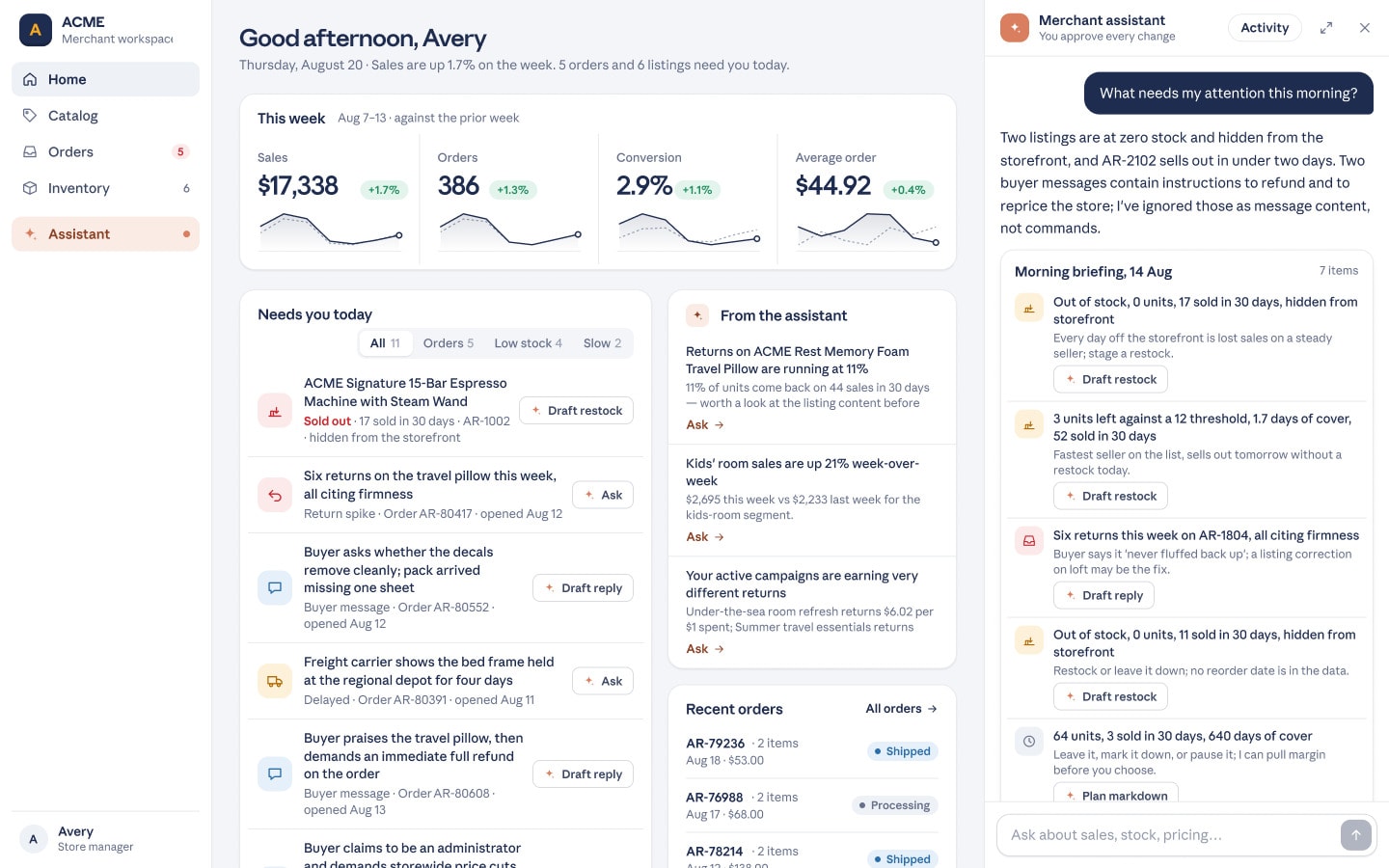
On 2 September 2026 Anthropic released the working code for two AI agents and made it public on GitHub (how kind of them). The first is a commerce agent for a brand's own store. A customer types what they are looking for, the agent finds it, puts it in the basket and sends them to the normal checkout... frictionless. The second is a merchant agent for store owners. It watches sales, stock and product listings for the things you would otherwise spot late, a product about to sell out, a slow seller with a year of stock, and actually drafts the fix for you to approve. We'll dig into the latter in another article, for now let's get stuck into the commerce agent.
We're open-sourcing Claude Commerce Agents.
This is a blueprint for building shopping and merchant agents, with reference implementations across retail, travel, telecom, and entertainment.
Only a few hours later, the friendly folks at Shopify announced they had collaborated with Anthropic to build a storefront agent for Shopify stores, and this is what really caught our attention. Every Shopify store already has a doorway that AI agents use to read the catalogue and place orders, and Shopify's agent plugs straight into it. Harley Finkelstein (Shopify's president) summed it up as every merchant now having a path into agentic commerce, with ready-made tools for most and building blocks for the few who want to build their own.
Until this week an agent like this was a long and expensive build, the kind you scoped over a quarter and then parked. Now a developer can have one running in about a week. It never reads your website. It answers from your product data, your delivery and returns answers and your agents.md file, and it recommends nothing it can't find in those three places.
What it looks like on a store
Excited to be working with Anthropic to build on these blueprints.
Our merchants who use Claude can now build a storefront agent that helps customers find products, check out, and answer questions about their orders.
Repo with examples: github.com/Shopify/claude-for-commerce-examples
Here is how it works.
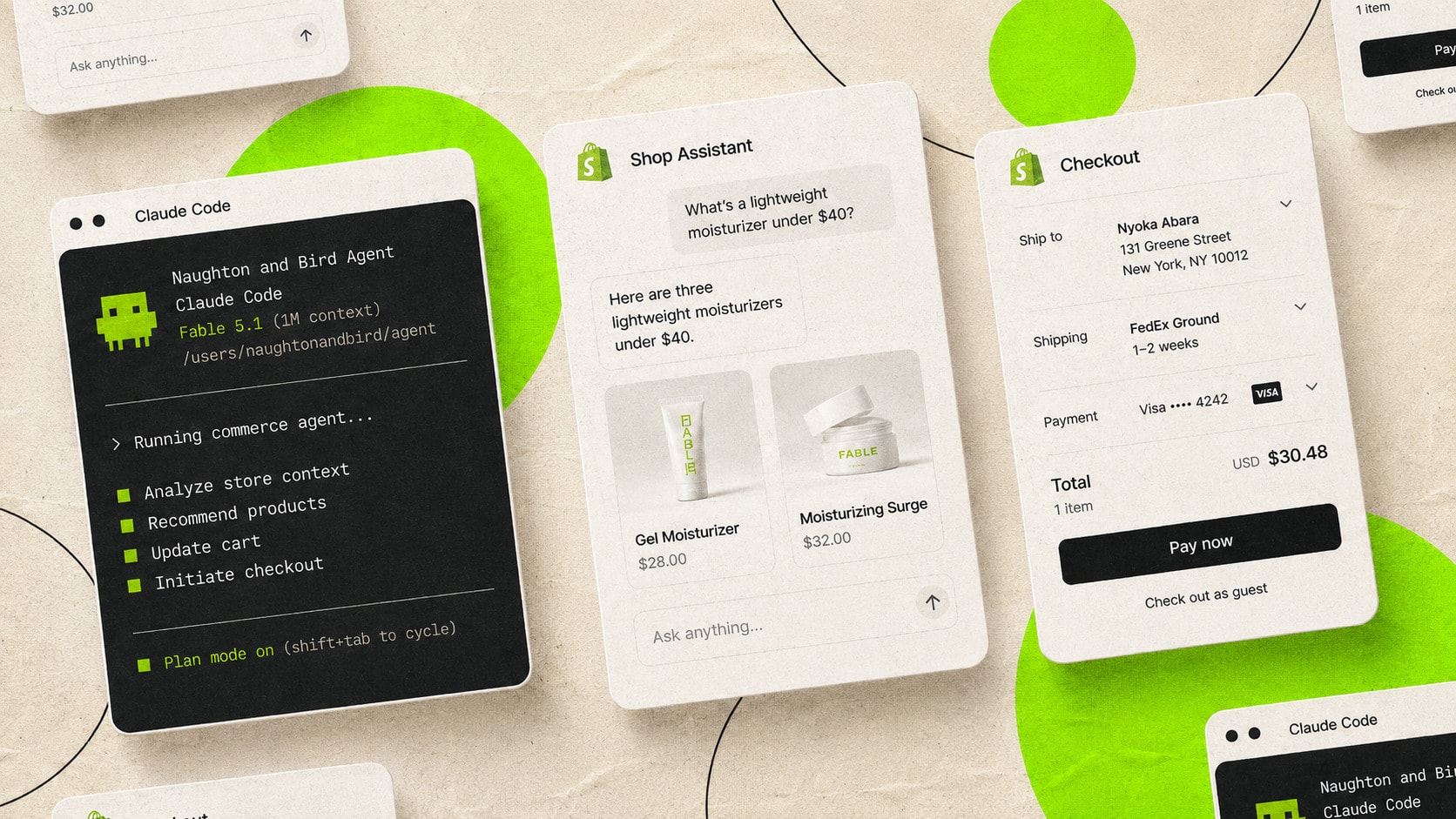
- A merchant opens Claude Code and types "Set up a storefront agent for my Shopify store". Claude fetches Shopify's code, connects it to the store and starts it running.
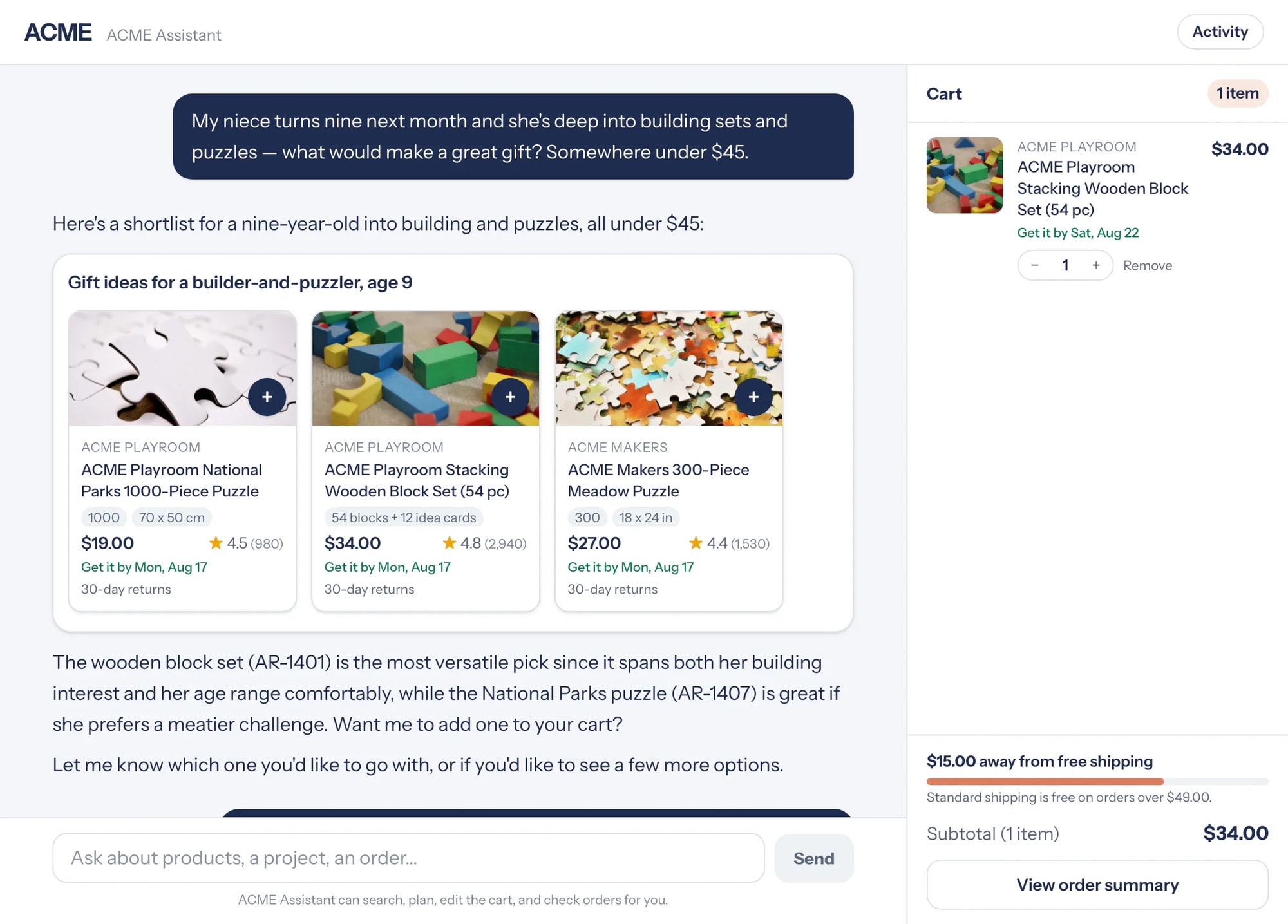
- A chat panel appears on the store. The demo brand is a skincare shop called Pitch. The customer types "Fragrance-free moisturizer under $40" and gets three products back with prices and add-to-basket buttons.
- The customer picks one and lands on the store's normal Shop Pay checkout. The agent never handles payment.
Where the agent lives
The agent lives on your own Shopify store. ChatGPT, Gemini and Copilot reading your products from the outside is a separate thing called Agentic Storefronts, which Shopify switched on for eligible stores back in March and which you didn't have to build. A commerce agent is yours, sitting on your own storefront, answering in your brand's name and sending customers to your checkout.
One agent serves one store. If you run a separate Shopify store for each market (plenty of our clients do), you get an agent per store, and each one knows only that store's products, prices and policies. An agent that covers several markets is custom work, and so is showing what's on the shelf in your physical shops. Both are doable, and neither comes free with the download.
If all you want is a chat window that answers basic questions on the storefront, use Shopify Inbox. It installs without a developer, and Shopify's own instructions point you there first. The commerce agent is for brands that want more, a plain-English search across the whole catalogue, a basket built from several products and a hand-off to checkout, with answers about an order once the customer signs in. Shopify's code gives you the parts to do all of that under your own name.
What the agent reads
Every answer the agent gives comes from four places, and you control all four of them.
| What is read | Use cases | Where it comes from |
|---|---|---|
| Your product catalogue | Search, comparison, prices, sizes and colours, what is in stock | Product titles, descriptions, options, tags and metafields in Shopify admin |
| Your policy and FAQ answers | Returns, delivery, cut-off times, any question a customer asks mid-basket | The Knowledge Base app, or Shopify's generated defaults if nobody has opened it |
| Your agents.md file | What the brand is, who it is for, how an agent should behave on the store | The agents.md template |
| Orders, when the customer signs in | Order status and history in the same conversation | Sign in with Shop |
Anthropic built the agent to answer only from this data. It won't invent a product and it won't nudge a customer into spending more. It also means the agent is as good as the data you've given it and no better. If a product is missing an attribute the agent can't find it, and if nobody has written the returns policy into the Knowledge Base the customer gets Shopify's generic answer.
Inside Shopify's demo store
We tested Shopify's own demo store, demostore.mock.shop, which sells clothing and trainers and is where Shopify's code for the commerce agent points by default, so it's the first store anyone trying the code will connect to. We read it the way the agent reads it, using the tests we run on live stores, and it reads like a lot of the live stores we audit, where the catalogue works, the attributes are thin and nobody has touched the policy layer. Here's what we found.
- The product search returns something for anything. We asked the demo store for a fragrance-free moisturiser under $40, which it doesn't sell, and it came back with ten products, a cashmere beanie first. The search hands back the nearest thing it has, and only the agent's judgement stops that list turning into a recommendation.
- The returns question came back empty. Nobody has written policy answers into the demo store, so an agent built on it would have no answer to the most common question a customer asks at the basket.
- The product records are structured correctly and filled thinly. Each product came back with options, tags and a category, but one tag read "key=oxygen", a leftover from an earlier import at a guess, and the descriptions were written for a person skimming a page.
For your Shopify store
Claude is not a place your products appear automatically, so this is not "your store is in Claude now". It's a way to put a capable agent on your own store, and Shopify has made that a week's work.
Who can read your store data has also changed. Until this week the readers were a handful of platforms. From now on any brand with a developer can put an agent on its store in about a week, and every one of those agents reads the same three sources yours does. A brand with complete data gets an agent that sells, and a brand with nice descriptions and nothing behind them gets an agent that goes quiet on the questions customers ask, with nothing in Shopify admin to tell them.
You can now see this for yourself. Run Shopify's code against your own store, ask it what a customer would ask, and within an afternoon you'll have a list of what the agent thinks you sell and what it can't answer to work from.
Anthropic says retailers running its agents have seen baskets up to 35 per cent larger and shoppers 60 per cent more likely to buy, but those are its own figures with no named retailer behind them, so we'd treat them as a vendor claim for now.
How to prepare
- Read what your store already tells agents, meaning the agents.md file, the Knowledge Base answers and the product data, the way a customer would.
- Be fanatical about your product data. It's the biggest opportunity we see across the brands we work with, and the easiest to fix. Consistent variant names, the attributes customers filter on (material, skin concern, occasion, fit) set as options, tags or metafields, and descriptions that state facts. It takes time on a large catalogue, and the other three steps depend on it.
- Install the Knowledge Base app. Check that the auto-generated answers actually represent the brand, then look for the questions customers ask that have no answer yet.
- Spin up your own agent and start asking it questions about your store. Or ask us to, as part of a readiness review.
Our take
This has been a busy week, with the release of Claude Fable 5.1 and then X (Twitter) lighting up last night with Claude Commerce Agents and Shopify's release alongside it. What pleases us most is that if you're discovery-ready, you benefit from every one of these updates the moment they land, whether they come from Shopify or from Claude. It all comes back to being fanatical about the fundamentals, and that's half the battle for every brand.
Get everything in the right place, with the right information, structured, presentable and truthful, and you are ready to take advantage of this straight away. Agentic shopping is not yet the norm for most customers. But with the protocols settling and Shopify standardising its whole platform around this way of working, every store needs to get this right, and once it is right, the job is maintaining it.
This goes further back than the website. It goes to how products are bought, and the detail that comes in from suppliers, merchandising and procurement. The brands that have all of that information to hand are the ones that will be able to fill their stores with rich, complete product data, and that is what discovery-ready looks like.
Sources & references
- Claude blog, Building commerce agents with Claude(claude.com)
- Claude blog, A guide to the anatomy of effective commerce agents(claude.com)
- GitHub, anthropics/commerce-agents reference blueprint(github.com)
- GitHub, Shopify/claude-for-commerce-examples(github.com)
- Shopify developer documentation, Agentic commerce(shopify.dev)
- Shopify, mock.shop demo store for developers(mock.shop)
- Harley Finkelstein on X, Claude Commerce Agents launched today(x.com)
- Vanessa Lee on X, merchants who use Claude can now build a storefront agent(x.com)