Contents
In briefThe definitionThe first agentic holidayThe readiness testA worked exampleThe order of workBefore Black FridayOur takeQuestionsRelated service
Shopify Agentic Commerce →The definition
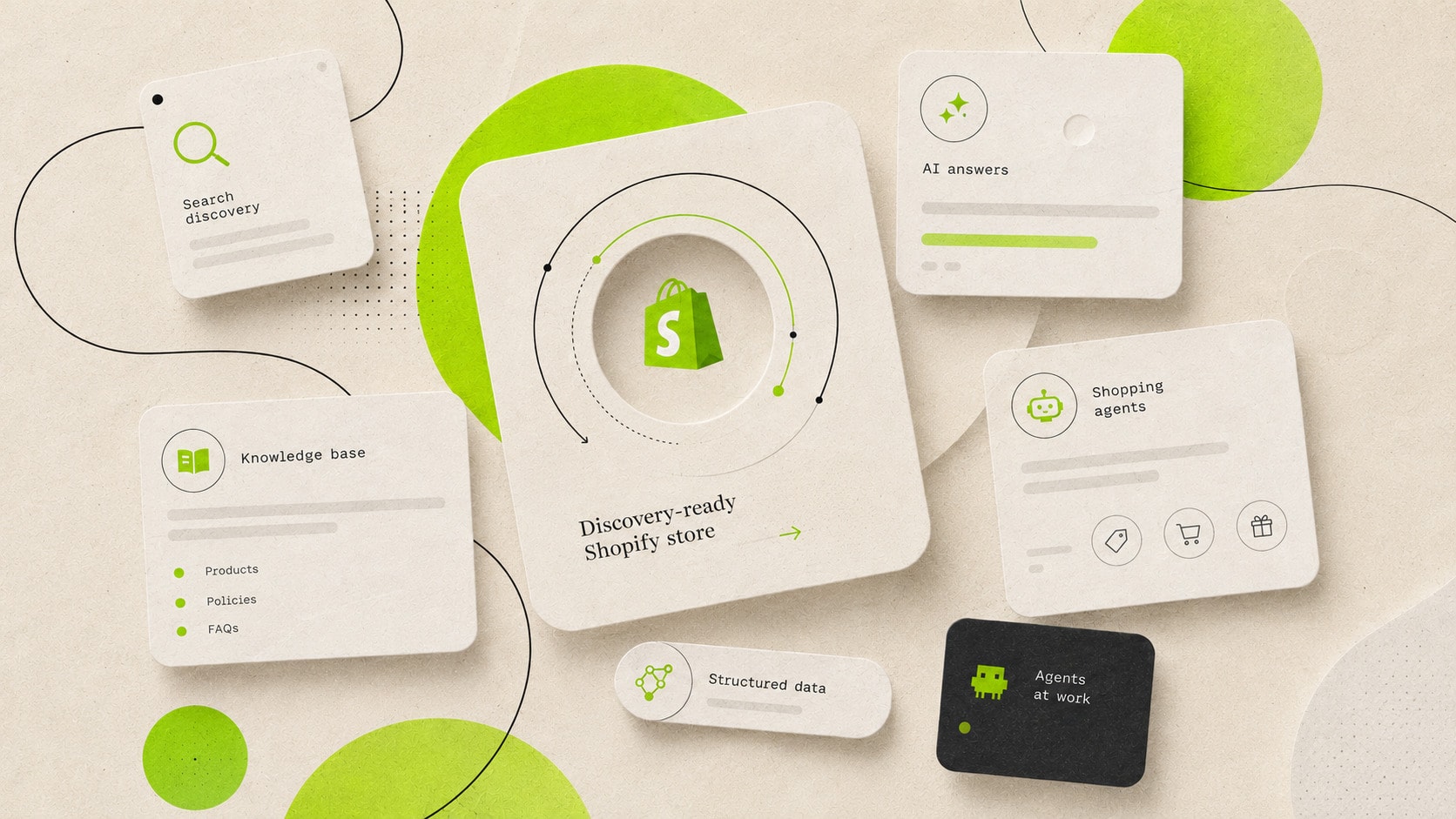
A discovery-ready Shopify store is a store prepared to be found and correctly represented on the three surfaces where customers now discover brands: organic search, AI answers, and shopping agents. Prepared means the data each surface reads, from site architecture and structured data to catalogue content, policy facts and the agent-facing files Shopify now serves on every store, is accurate and complete, and states the same facts wherever it appears.
We coined the term because the state it describes did not have a name, and the work it describes was being treated as three separate projects. An SEO agency owns the first surface, an AI visibility tool watches the second, and nobody owns the third, even though all three read the same store.
Readiness is also a filter, because a brand nobody is looking for has nothing to gain from being easier to find, so the standard assumes a store with real equity, real demand for its name, and a gap between the two.
The three surfaces, and when each one arrived
Organic search needs no introduction, and it still carries most category demand. A buyer who wants walking boots or a birthday necklace still types the query into Google more often than anywhere else, which is why the fundamentals of search remain the base of the discovery-ready standard.
AI answers arrived in two waves. Google announced the US rollout of AI Overviews in May 2024, and Pew Research Center measured what that did to behaviour: clicks on conventional results fell to 8 percent of visits when a summary appeared, from 15 percent without one, with links inside the summary clicked 1 percent of the time. ChatGPT search launched in October 2024, reached all logged-in free users that December, and dropped its sign-up requirement in February 2025. The buyer increasingly reads an answer instead of a results page, so the brands named in the answer collect the demand.
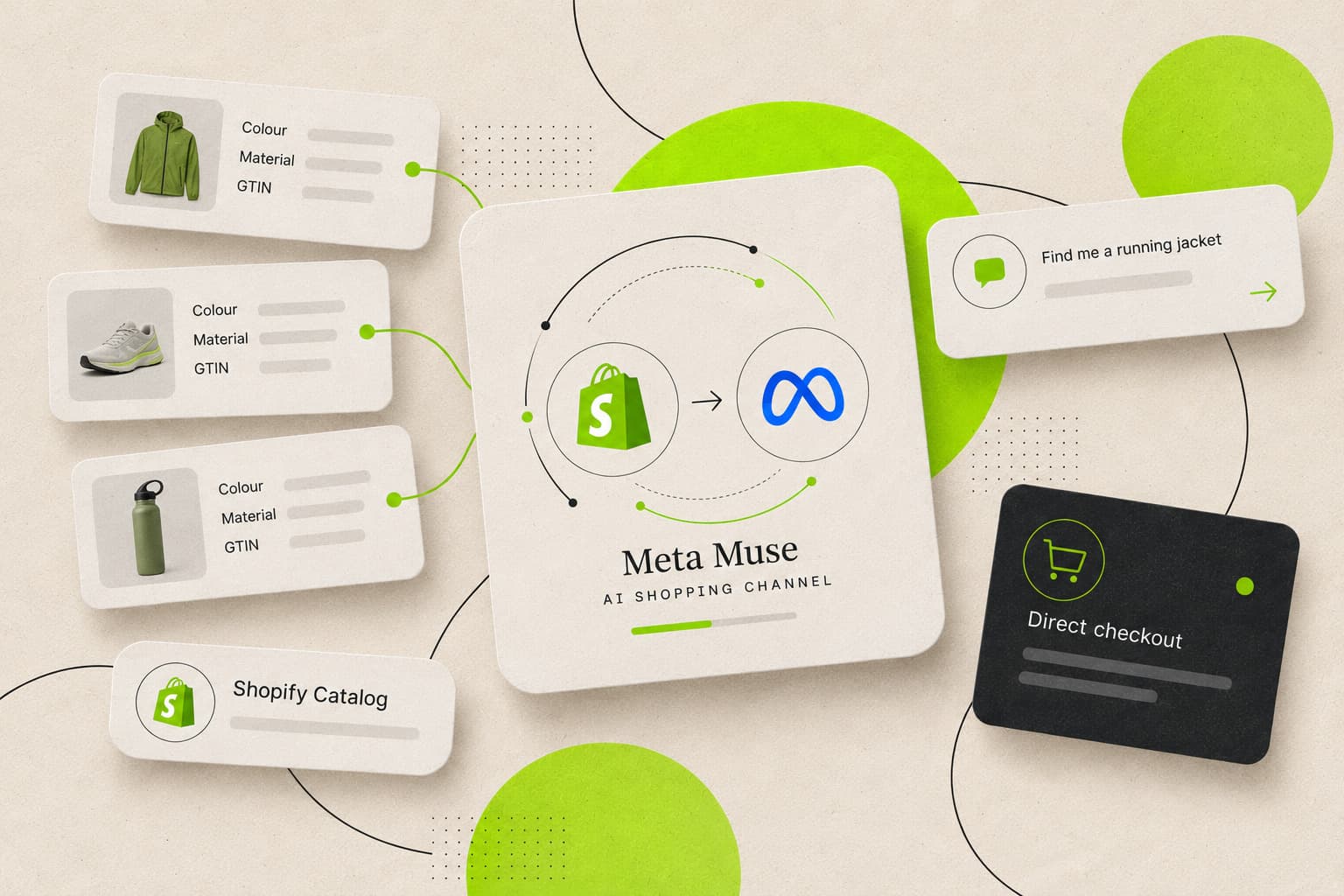
Shopping agents are the newest surface and the one that changed status this year. On 24 March 2026 Shopify announced that products from millions of eligible stores had become discoverable in ChatGPT by default through Agentic Storefronts, managed from the Shopify admin alongside Microsoft Copilot, AI Mode in Google Search and the Gemini app. Shopify Catalog structures the product data those platforms read, keeps prices and inventory current, and attributes orders back to the originating channel.
| Surface | Reads your store since | What reads it | What it reads |
|---|---|---|---|
| Organic search | Always | Search engine crawlers | Architecture, content, structured data, links |
| AI answers | 2024 onwards | AI models and their browsing tools | Entity signals, citable content, third-party coverage |
| Shopping agents | March 2026, on by default | Shopify Catalog, storefront MCP, agent clients | Product data, policy facts, Knowledge Base, discovery files |
The first holiday season of the agentic era
On 6 October 2026 Shopify called this the first holiday season of the agentic era, the first in which a shopper can ask an agent to find a product, compare it and buy it without leaving the conversation. Shopify's 2026 Global Holiday Retail Report, the study the post cites, finds that 65 percent of shoppers are likely to use AI for at least one shopping task over the whole holiday shopping period.

Being listed is automatic and being chosen is not
The March 2026 switch settled whether your store is in the agentic channel: if it is eligible, it is in, and so is every competitor. Which store the agent recommends when a buyer asks for the best option in your category is still open, because that decision runs on the quality of the data each store exposes.
Shopify reported the merchant side of that split on 6 October 2026. Stanley 1913 had five times as many AI-referred orders in the US as the same window last year. ILIA's AI-referred sales nearly tripled year on year, and Cottonique's AI-referred sales grew 276 percent. Shopify attributes those results to a year spent making the store legible to agents, so an agent can read what the brand sells, who it sells to, and whether it can be trusted.
An agent never sees your theme, your art direction or your homepage film. A human shopper in a well-stocked shop with no signage will wander the aisles and work it out, but a buyer's agent reads what the store publishes in structured form, and where it finds nothing useful it moves to the store next door and reads that instead.
The work underneath discovery-readiness is therefore data work, and the stores that did their foundations properly, clear architecture, complete product data, accurate policies stated where machines can read them, were most of the way there before the channel existed.
What each surface reads on a Shopify store
The three surfaces share a common base. Collection architecture tells every reader what the commercial territory is, and product titles, descriptions and metafields carry the detail an agent builds a recommendation from. Schema markup makes prices, availability and reviews machine-readable, and policy pages state the terms a buyer's agent has to relay correctly.
On top of that base, Shopify has shipped a layer that exists only for agents, and most merchants have never looked at it:
- Discovery files on every store: /agents.md, /llms.txt and /llms-full.txt, all serving identical Shopify-generated content by default, editable through theme templates since 28 May 2026.
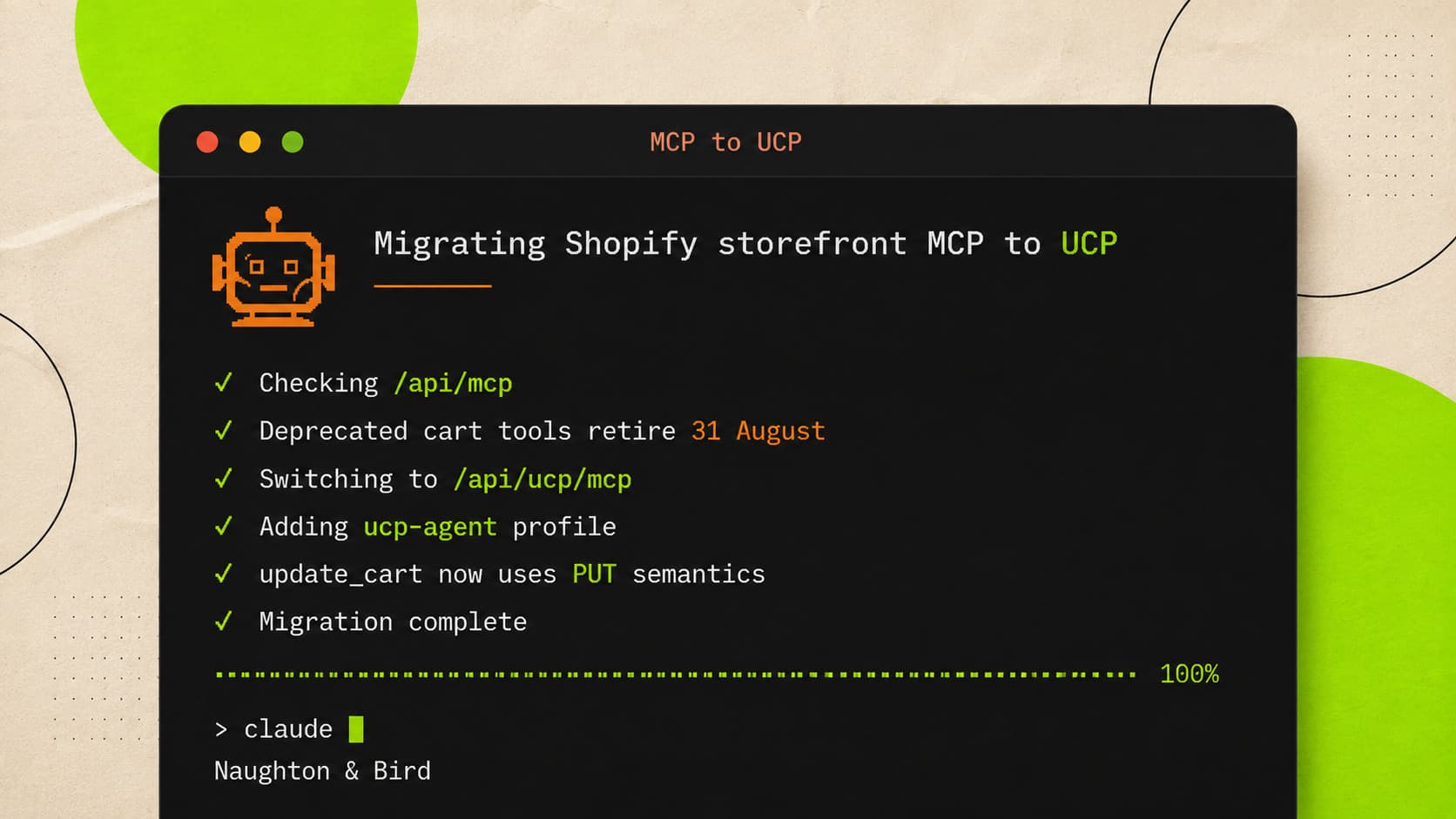
- The Universal Commerce Protocol manifest at /.well-known/ucp, generated from store configuration, which tells agents what the store can do.
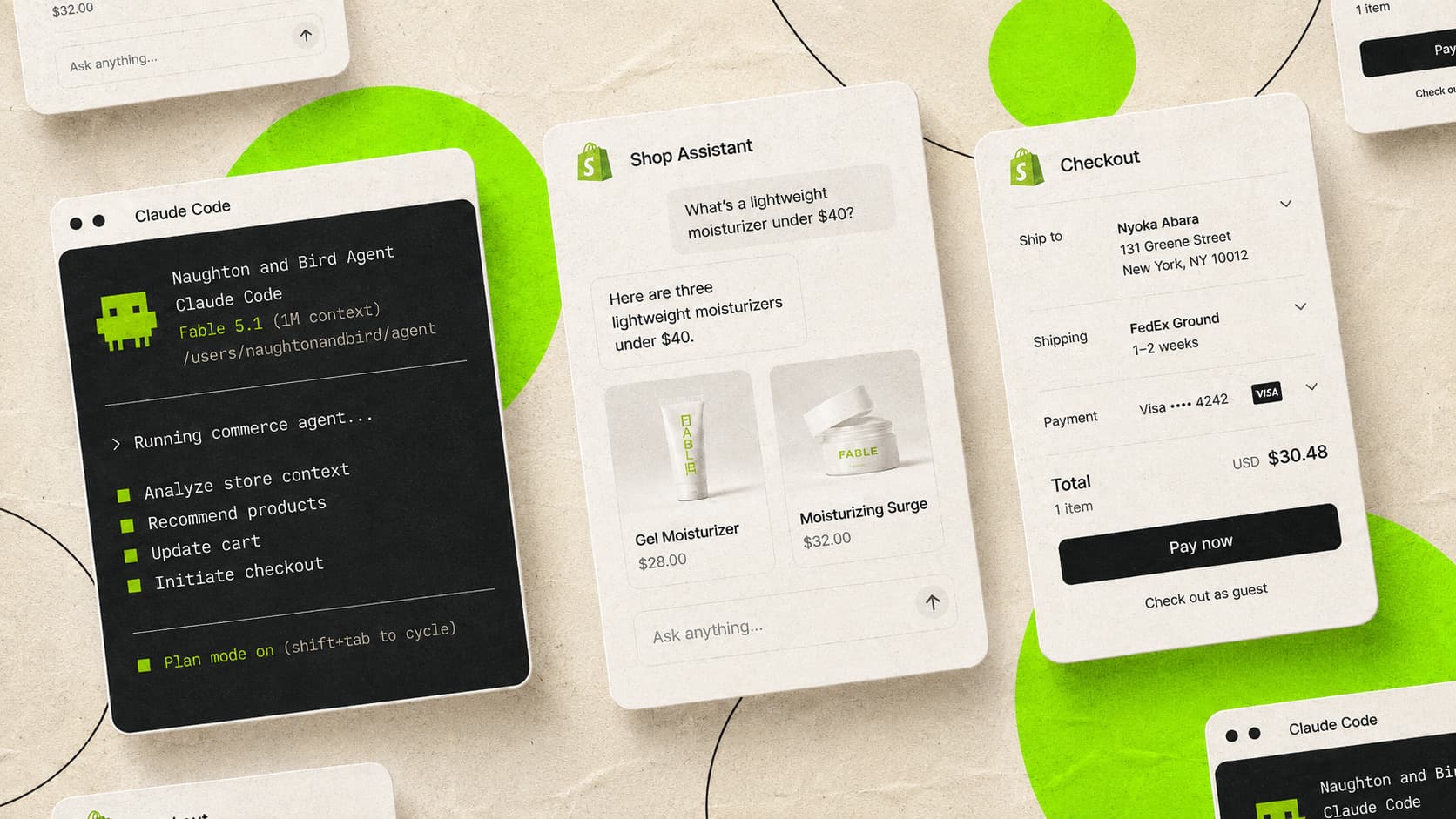
- The storefront MCP endpoint, which lets any compatible agent search the catalogue, read policies and manage a cart over plain JSON.
- The Knowledge Base app, the store's question-and-answer feed for AI surfaces, auto-populated from store settings whether or not the merchant has ever opened it.
- An agentic discovery sitemap linking the three discovery files, listed inside the standard sitemap index.
The weight this layer carries is limited. Ahrefs analysed 137,000 domains and found 97 percent of published llms.txt files never receive a single fetch, and Google has said plainly that it does not use them. The files matter because Shopify's own agentic systems read them and because they are where a store's data discipline becomes visible, and the heavier levers for being found and represented correctly are the catalogue data, the Knowledge Base and the schema, with the files as the cheap, fast layer on top.
The readiness test you can run this afternoon
You can establish where a store stands in under half an hour, without a developer and without logging into anything beyond your own admin.
- Read your discovery files. Load /agents.md, /llms.txt and /llms-full.txt on your own domain. If all three are identical apart from one line naming the path, the store is serving Shopify's default, which contains the transaction protocol and no brand content at all.
- Ask your store a question. In the Shopify admin, open the Knowledge Base app if it is installed and read the auto-generated answers against your actual policies, starting with returns and shipping. If it is not installed, that is the first finding.
- Check the schema. Run your homepage and one key collection through Google's Rich Results Test and note what is present. On most stores, product schema exists and FAQ, aggregate rating and return policy markup do not.
- Read a top collection as a stranger. If the page is a product grid without an introduction, buying guidance or answers to the category's obvious questions, an agent following that link learns nothing it can cite.
- Run two category queries in ChatGPT. Use the questions a buyer would ask, without your brand name, and note who is recommended, in what language, and whether the details are accurate. The result is your current position in the channel.
Record what you find, because the same five checks run after the work is done are the before-and-after. Everything in the list is inspectable from outside except the Knowledge Base, which is why we treat the feed it powers as the first thing to capture properly, and there is a longer testing guide covering how to query the endpoints agents call.
What we find when we run it
We run this test as the opening step of every agentic readiness engagement, and the pattern across live stores is consistent. The discovery files are the untouched default on almost every store we have read, and the Knowledge Base, where installed at all, is running on auto-generated answers nobody has reviewed.
The feed serves answers whether or not anyone has curated it, errors included. When we captured a live store's policy feed against a set of 28 questions a shopper would ask, nearly half came back with no answer at all. Among the answers that did come back, the returns policy quoted a window that did not match the store's published terms, a click-and-collect question was answered with a raw internal location ID instead of an address, and a gift service was advertised that the store does not offer.
Every one of those answers was being served to shopping agents that day, on a store whose team had no idea the feed existed, and nothing had ever prompted anyone to look. Most of the platform has been in the same state since the March 2026 switch, enrolled in the channel and represented by defaults.
Before curation, the click-and-collect question came back as a system record, along the lines of "Location ID: 627296…, Pickup price: 0.00, Pickup time: twentyFourHours". A curated answer to the same question reads like a person wrote it: collection is free from the flagship store, usually ready within 24 hours, with the address written for a buyer. The wording will differ by store, and the gap between a leaked system record and an answer someone stands behind is the same everywhere.
A worked example: one fact, four places
Following a single fact through the store shows what readiness means in practice. Take a returns window of 21 days, the kind of term every store has and every buyer's agent will be asked about.
| Where it lives | Who reads it | What it must say |
|---|---|---|
| The returns policy page | Customers, crawlers, browsing agents | The full terms in plain language: 21 days from delivery, condition requirements, the process |
| MerchantReturnPolicy schema | Search engines, structured-data consumers | merchantReturnDays: 21, with the return method and fees fields matching the page |
| The Knowledge Base answer | AI platforms and shopping agents | A one-to-two sentence answer stating 21 days and the one condition that most often trips buyers |
| The agents.md policy block | Shopify's agentic systems, MCP-aware agents | The same 21 days stated inline, next to the link to the full policy |
The number has to be identical in all four places. A mismatch is worse than an omission, because an agent that reads 21 days in one place and 14 in another has learned that the store's data cannot be trusted, and an agent that finds nothing at least knows to say so. This is also why the work resists being split across three suppliers, since whoever owns the returns page rarely owns the schema and nobody owns the feed.
Multiply that discipline across shipping terms, guarantee terms, sizing, stockists, bestsellers and the questions specific to your category, and you have the substance of discovery-readiness. It is unglamorous work, doable in-house once someone owns it, and this is the detail the agent's recommendation turns on.
The order of the work
The layers read each other, so the order matters more than the effort. Knowledge Base answers are generated from store settings and policies, catalogue search returns whatever the product data contains, and the discovery files are only as useful as the facts behind them. Fixing the surface layer first means restating errors more visibly.
- Architecture and catalogue first: consolidated collections that map to real demand, product data with the detail a recommendation needs, accurate policy pages.
- Structured data second: product, FAQ and policy schema stating the same facts the pages state.
- The agentic layer third: Knowledge Base answers reviewed and corrected, a custom agents.md carrying the brand and its actual terms, robots.txt letting AI crawlers in.
- Verification last: the same five checks re-run, and the category queries repeated a few weeks later.
This is the same fundamentals-first argument we make for organic search, extended one surface further. The agentic layer adds a new reader at the end of the hierarchy, and the guidance on what a custom agents.md should contain follows the same principle.
Before Black Friday, make the case machine-readable
Shopify's holiday note says the reflexive merchant response is to discount deeper and earlier. An agent asked whether a product is worth the price can see the price immediately. Product intent, who it is for, and the proof of value have to be written where the agent can find them, or the discount is the only fact the agent can repeat.
Run the readiness test first, so you can see what an agent currently reads, then make the edits in the same order as any other week:
- Catalogue: product titles, descriptions and metafields that state what the product is for, who it is for, and why the price is justified.
- Schema: those same facts in structured data, agreeing with the pages.
- Knowledge Base and agents.md: the answers and the policy block an agent will relay, stating the same facts again.
Do the five checks again once the edits are in. This year the deadline is before Black Friday and Cyber Monday.
What discovery-readiness will not do
It will not guarantee citations or recommendations. Shopify is explicit that Knowledge Base curation corrects what AI platforms say about a store, without changing how often it appears. Appearance is decided by the model's wider view of the brand, which is built from authority, coverage and entity clarity over time.
It will not restore the click volumes of 2023. Pew's data shows AI summaries reduce clicks even for the sources they cite, and no amount of readiness reverses that. The realistic goal is to be the brand the answer names, with the store data that lets an agent transact correctly when the buyer acts on it.
And it is not a state you reach once. The protocol versions in the agent files update, models change how they read, and Shopify is still building the channel out. Readiness is maintained the way any fundamental is maintained, which is why it belongs with the rest of the foundational work.
Our take
We gave it a name because we kept seeing the same problem. If every brand did its fundamentals properly there would be no need to offer this as a service. The trouble with calling it SEO is that SEO carries years of bad connotations, and this is good practice in e-commerce. It goes much deeper than putting a patch on a website. It is about the whole organisation being on board with how it operates, so the e-commerce side gets the maximum value out of what the business already knows. Search discovery is the term the industry is settling on, Shopify uses it too, and we wanted to be an early adopter of it.
We do not run the readiness test live with a client. We run it in the background and present what we found, and the reaction is the same whether it is the owner, the CEO or the e-commerce director in the room. They get the idea of agents being spawned mid-conversation straight away, and they had no idea any of this was there, and that is where the education happens. Some clients then want to learn along the way with us and some just want the output done, and either way we do the output.
The early mover advantage is now. With anything on an adoption curve the early movers benefit most, and most people do not even realise they are spawning agents mid-search with Gemini or ChatGPT, but that is what is happening. Whether every brand gets there we are less sure, because many do not have the capacity or the experience to navigate it and are relying on specialists like us to translate their brand signals into a discovery-ready methodology. Only the brand knows its own deepest processes, and if that is not being fed into the technology the technology cannot know it.
A lot of the discovery-ready work sends us back into several departments to get the answers out, which takes time. The early mover advantage sits with the brands that already run a tight ship, their procurement, their brand story and their mission sitting in a shared drive or a DAM (a digital asset management system) ready to be pulled. They are prepared without realising they are prepared.
Questions we hear about discovery-readiness
No. Organic search is one of the three surfaces, and the fundamentals overlap deliberately, but the agentic surface has infrastructure of its own: discovery files, the Knowledge Base feed and the storefront endpoints that agents query directly. SEO work alone leaves that layer at its defaults.
If it is eligible for Agentic Storefronts, it has been included by default since 24 March 2026 and you manage the channels from the Shopify admin. The work that remains is being the store the agent chooses and represents correctly.
Less than the industry noise suggests and more than zero. External AI crawlers barely fetch them and Google does not use them, but Shopify's own agentic systems read them, and they are quick to do properly once the underlying facts are right.
No. The discovery files, the Knowledge Base app and the storefront endpoints ship on every Shopify store. Plus brands tend to have more products, more markets and more at stake, which changes the scale of the work, and the mechanics are the same on every plan.
Orders from AI channels carry channel attribution in the Shopify admin, the Knowledge Base reports how often agents request store information and which questions go unanswered, and periodic category queries in the AI platforms track whether the brand is being named. Measurement stays with your team and your own tools.
Sources & references
- Shopify, Agentic commerce momentum: millions of merchants can now sell to ChatGPT users(shopify.com)
- Shopify Help Center, Shopify agentic storefronts(help.shopify.com)
- Shopify developer changelog, Customize /llms.txt, /llms-full.txt and /agents.md(shopify.dev)
- Shopify Help Center, Knowledge Base(help.shopify.com)
- Pew Research Center, Google users are less likely to click on links when an AI summary appears(pewresearch.org)
- OpenAI, Introducing ChatGPT search(openai.com)
- Ahrefs, We analyzed 137K sites: 97% of llms.txt files never get read(ahrefs.com)
- Shopify, Welcome to the first holiday season of the agentic era(shopify.com)
- Shopify, 2026 Global Holiday Retail Report(shopifyholidayretail.com)