Contents
In briefWhat changedThe datesWho this affectsWhat to doOur takeRelated service
Shopify Agentic Commerce →What changed
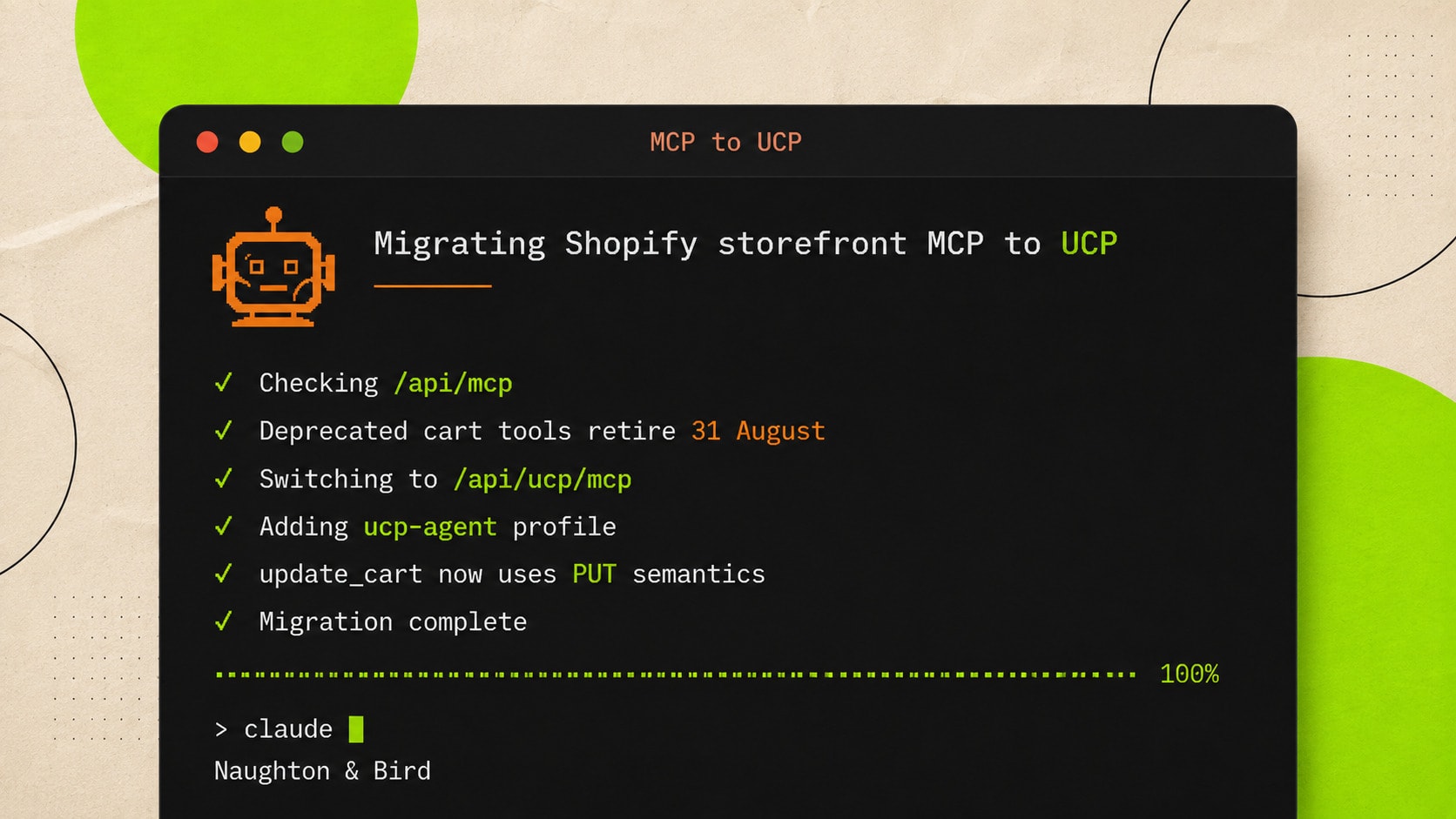
Shopify's developer changelog of 24 June 2026 deprecates the get_cart and update_cart tools on the storefront MCP endpoint at /api/mcp, the interface AI shopping agents call to search a store's catalogue, read its policies and manage a cart. The deprecated tools stay live until 31 August 2026, and after that date anything still calling them stops working.
The replacement is a set of Cart MCP tools conforming to the Universal Commerce Protocol, served from a new endpoint at /api/ucp/mcp on every store: create_cart, get_cart, update_cart and cancel_cart. The change completes a migration that started in the spring, and it is the part with a hard deadline attached.
The dates that matter
This is the second half of a two-stage move. The catalogue tools crossed first, and some integrations discovered that the hard way when the old search tool disappeared and their agent connections broke mid-season, a failure mode documented at length on Shopify's own developer forums.
| Date | What happened |
|---|---|
| 22 April 2026 | Catalogue tools reworked to UCP shapes: search_catalog, lookup_catalog, get_product |
| 15 June 2026 | Legacy catalogue tools discontinued |
| 24 June 2026 | Cart tools on /api/mcp deprecated |
| 31 August 2026 | Deprecated cart tools retired, and the old integration path closes |
What UCP is, briefly
The Universal Commerce Protocol is the standard Shopify is consolidating its agent-facing commerce interfaces around. Every store already publishes a UCP discovery manifest at /.well-known/ucp describing what it supports, and the protocol defines the request and response shapes agents use to search, cart and check out.
The practical difference from the old storefront MCP is stricter conformance. Calls to the UCP endpoint carry a meta object with a ucp-agent profile, cancel_cart requires an idempotency key, and update_cart uses PUT semantics, so each request replaces the cart's full state and an integration that patches single fields will silently drop the rest of the cart.
Who this affects
If you run a standard store you have nothing to migrate, because Shopify operates both ends of the pipe for the agentic storefronts channel. Your store's own agents.md continues to state the endpoints, and Shopify has been updating the defaults as the protocol moves.
The deadline lands on anyone who built directly against /api/mcp: custom agent integrations, conversational commerce tools, internal chatbots wired to the cart tools, and any agency-built middleware from the first wave of storefront MCP experiments in 2025. If something in your stack transacts with your store through MCP and nobody has touched it since the spring, this is the moment to find out what it calls.
What we saw when we tested it
When we query a live store's /api/mcp endpoint, every response now carries the migration notice inline, stating the 31 August cutoff and pointing at the Cart MCP documentation, so any developer reading their own logs has been told.
We also probed the new /api/ucp/mcp endpoint directly. It is live and it rejects anonymous calls that carry no UCP agent profile URI in the request metadata, which the old endpoint never required. Audit tooling and ad hoc scripts that treated the storefront MCP as an open query surface will need the profile field from day one on the new path, and that requirement is easy to miss in a quick port because the old calls fail with a protocol error rather than an obvious authentication message.
What to do before 31 August
- Inventory anything that calls /api/mcp on your store, including tools built by past agencies. The store's own logs and the developer responsible for each integration are the fastest route.
- Migrate cart calls to /api/ucp/mcp and adopt the UCP shapes: the meta object with the agent profile on every request, an idempotency key on cancel_cart, and full line_items on every update_cart call.
- Retest the full flow after migration, from catalogue search through cart to checkout handoff, because the PUT semantics change is the one that fails quietly.
- If nothing custom touches the endpoint, confirm that and move on. The agentic storefronts channel itself migrates with the platform.
Beyond the deadline, Shopify is standardising the layer agents transact through, and each migration tightens the assumption that your store's data is structured and accurate. Get the store discovery-ready now, ahead of the next protocol update.
Our take
When we tested the endpoints across client stores, most had nothing optimised. They were letting Shopify present its synthesised answers, and half the time that was because nobody knew the endpoint was there. It is live on every store whether or not anyone has looked at it, so the first job is to read what it is saying about you.
Sources & references
- Shopify developer changelog, Storefront MCP cart tools are being deprecated in favour of UCP Cart MCP(shopify.dev)
- Shopify developer changelog, Storefront Catalog MCP now implements UCP(shopify.dev)
- Shopify developer documentation, Cart MCP(shopify.dev)
- Shopify developer community, search_shop_catalog tool vanished without notice(community.shopify.dev)