Hong Kong SEO

Three search languages. Customers who expect same-day delivery and in-store pickup, and cross-border shoppers researching on platforms most Western agencies have never tested. We have been on the ground since 2019, building discovery-ready stores for the way this city actually shops.

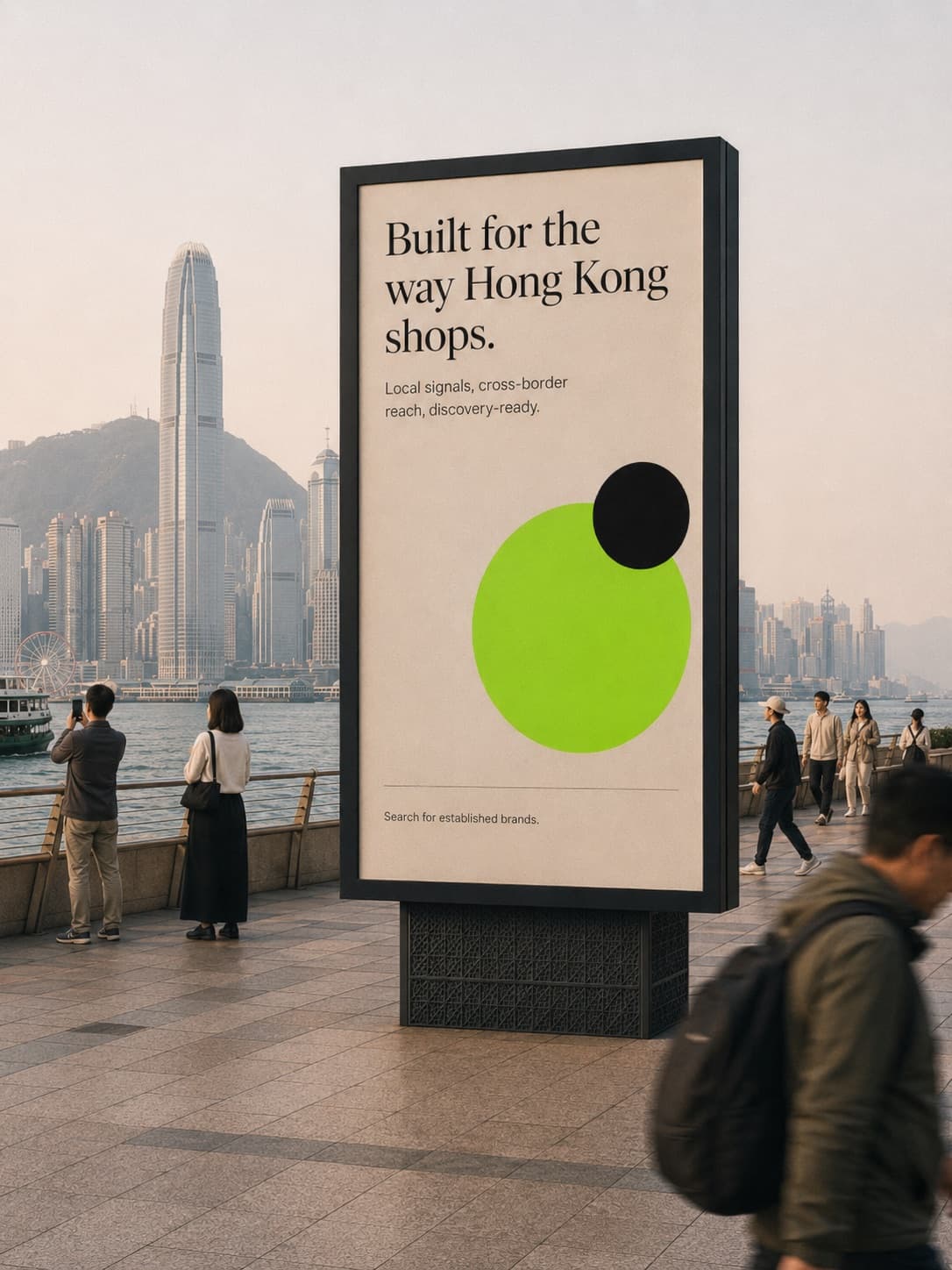
A billboard on the Tsim Sha Tsui promenade reading Built for the way Hong Kong shops, the Central skyline across the harbour
APM Monaco
Libertine Flowers
TREE
Rosewood Hong Kong
Feather and Bone
Corney & Barrow
Nutrition Kitchen
Habitat Property

Why Hong Kong

Hong Kong has a shopping culture that no other city quite replicates, and search strategy here has to reflect that

Customers research in English, Traditional Chinese, and Simplified Chinese, sometimes in the same session. They expect to find a brand online, confirm it has a physical presence, check same-day pickup or delivery, and see content that speaks to them. Cross-border shoppers from the mainland research through AI tools and platforms that most Western agencies have never considered. And for brands shipping internationally from Hong Kong, the search signals that trigger buying decisions abroad look nothing like the local ones.

The opportunity is significant precisely because the market is layered. Brands that invest in understanding it, the audience mix, the language signals, the local and cross-border customer journey, find far less competition than they expect for commercially valuable search territory.

Three things that make Hong Kong search different

01

Three search languages

English serves expats and international visitors. Traditional Chinese serves local Hong Kong residents. Simplified Chinese opens cross-border reach into the mainland. Getting the language strategy right, and knowing when each audience matters commercially, is where the real edge is built.

02

Physical and online, inseparable

Hong Kong customers expect to find a brand online and confirm it exists physically, with local pickup options, same-day delivery, and stock they can trust. Search strategy here has to account for how people actually move between digital and physical in a city this dense.

03

No single AI model in market

Google still dominates search, and around it sits the widest spread of AI models anywhere: ChatGPT, Claude, Gemini, Perplexity, Kimi, Doubao, DeepSeek, and Poe, each serving a different slice of the city. Being visible across the right models for your specific audience is a meaningful competitive advantage.

On the ground

Before strategy, most Hong Kong businesses have a signals problem

Seven years on the ground

We have been working with Shopify brands in Hong Kong since 2019, and the consultancy was founded here by Matt Naughton, who had spent the decade before that growing an e-commerce business of his own. We know what it costs when the foundations are wrong, because we paid that cost as operators long before we advised anyone on it.

The pattern we keep seeing

The brands we work with here are established businesses, some trading for ten, fifteen, twenty years, and they often share the same underlying issue. A business moves premises, an agency builds citations pointing to the old address and then the relationship ends, another agency arrives and creates a different set of signals, domains change, and old sites get abandoned with no redirects to carry what they earned. Nobody has been there throughout, so nobody can paint the whole picture.

What this produces

What you are left with is a brand that has traded successfully for years, but whose digital footprint tells three or four conflicting stories at once. Google, and the AI models now trying to establish entity authority, cannot reconcile them. They default to uncertainty, which means lower rankings and weaker citation presence than the brand deserves.

Where every engagement starts

This is the first thing we look for in every Hong Kong engagement, and it is what the Readiness Review is for, establishing what is actually there before anyone decides what to build.

Every agency you've worked with has left a signal somewhere. The question is whether those signals agree with each other, and whether Google and the AI models your customers use can make sense of them.

Matt Naughton · Founder, Naughton & Bird

Hong Kong SEO

Selected Hong Kong work

All Work →
APM Monaco Été campaign, gold jewellery worn against the Mediterranean

APM Monaco

APM Monaco is an accessible luxury jewellery brand founded in Monaco in 1982, with creative direction still inside the founding family and seven regional Shopify Plus stores serving markets from the UK to Japan.

Read →

The Rosewood Hong Kong tower at Victoria Dockside

Rosewood Hong Kong

Rosewood Hong Kong stands at Victoria Dockside in Tsim Sha Tsui, named No. 1 on The World’s 50 Best Hotels 2025, with a Shopify store carrying the hotel’s retail collections beyond its walls.

Read →

AI Search in Hong Kong

Hong Kong has not standardised on a model, and that changes the work

What we see inside businesses here

Sit with a Hong Kong team and ask what they use, and every person at the table gives a different answer. One is on Poe, one on Kimi, one on DeepSeek or Doubao, someone runs ChatGPT through a VPN, someone else Claude the same way, and Gemini is there because the office runs on Google. Professional adoption started slower here than in the West, but it is happening now, at every level, and it is happening personally: people bring their own model to work the way they once brought their own phone.

Why the mix matters for search

There is no standard model to optimise for, and there will not be one soon. A brand cannot pick the winner and bet on it, because its customers have not picked one either. What every model rewards is the same ground: entity signals that agree with each other, structured content, and specific answers to specific buying questions, in the language each audience actually shops in.

Where the advantage sits

Most brands here have never tested what any model says about them, let alone the full spread. A store built to be read, by Google, by the Western models, and by Kimi, Doubao, and DeepSeek for the mainland-connected audience, is visible across the whole mix without betting on a single winner, and very few Hong Kong competitors have done that work.

Is your store discovery-ready?

Find out exactly what your Shopify store is telling crawlers and agents.

Request a Readiness ReviewShopify Plus Partner

Hong Kong SEO FAQs

No, and this is where the exercise usually goes wrong before it starts. Auto-translation moves the words across. It does not move the brand across. Hong Kong readers sit fluently between English, written Chinese, and spoken Cantonese, and each register carries its own weight: the formal, slightly literary tone that suits a returns policy reads stiff and imported on a product page, and the warmer, Cantonese-inflected tone a product page wants would read wrong on a legal notice. A machine translation cannot make that call, and it defaults to a neutral Mandarin-standard phrasing that a Hong Kong reader identifies immediately as not written for them. The brand already made this decision once, in English, when it chose how formal or how warm to sound. Localising for Hong Kong means making that decision again, deliberately, in Chinese.

Established doesn't mean discoverable, and that gap is usually where the opportunity sits. A competitor trading in Hong Kong for fifteen years usually has more brand recognition than search authority, because their own signals, old addresses and agency handovers among them, rarely tell one clean story. Resolving your own version of that, if it exists, moves quickly because the authority is often already there. Genuine new territory takes a season to build regardless of who else is in the category, but a strong incumbent's weak search presence is rarely as strong a wall as it looks from outside it.

Local SEO reaches people in Hong Kong searching for products or services they can buy, collect, or receive today. International SEO reaches people outside Hong Kong who want to order from a Hong Kong brand, whether that is cross-border shoppers from the mainland, gifting customers sending to someone in Hong Kong, or a brand building a global audience from an HK base. The content strategy for each is different, and mixing them up produces weak results for both.

If any part of your customer base includes mainland Chinese shoppers, people ordering cross-border, gifting into Hong Kong, or researching brands on platforms they use at home, then yes. Kimi (Moonshot AI) and Doubao (ByteDance) are widely used on the mainland and increasingly in Hong Kong. Being cited only in Western LLMs is not enough if that is where your buyers start their search.

Agencies have structural incentives that we do not. An agency needs to keep you on retainer, which means the work is rarely finished and the reporting is calibrated to justify next month's invoice. Our goal is different: we want you to own the knowledge, the data, and the compounding growth of the strategy. We can do the heavy lifting. But the part that compounds over time requires your brand to understand what is being built and why. We also have no platform referral arrangements. We recommend what is right for your business. Most agencies never tell you either of those things.