Shopify SEO

The Shopify brands that rank have three things in common. A commercial territory map that tells them which search terms move revenue. A technical foundation that search engines can read clearly. A content roadmap built around what buyers actually search for.

Alongside Shopify Agentic Commerce, it is one of the two pillars an established store now stands on, and the programme below is the one we run with our client brands today, phase by phase.

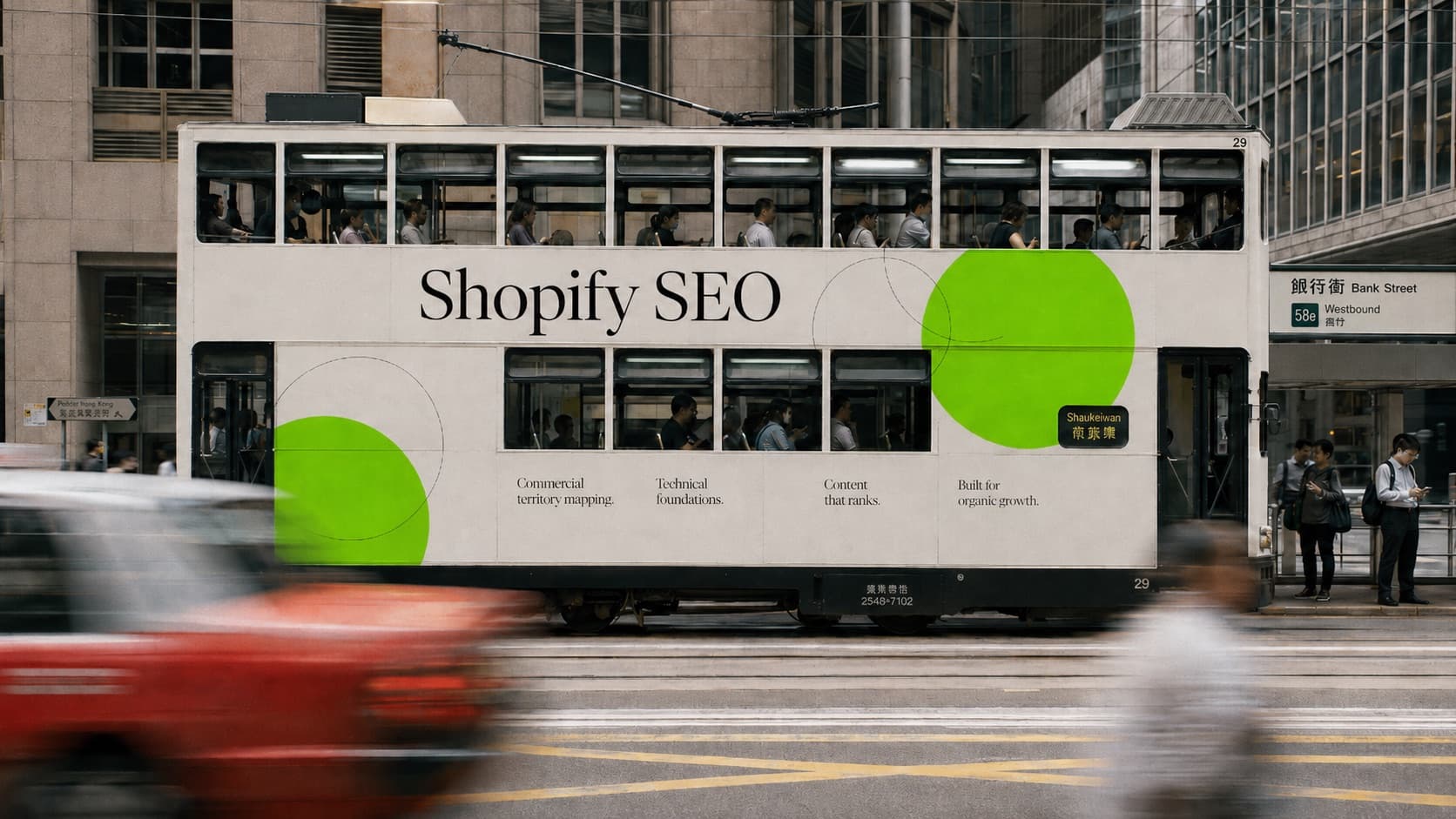
A Hong Kong double-decker tram carrying a Shopify SEO livery passes the Bank Street stop

Paid acquisition costs rise year on year while organic compounds, which makes this a commercial decision long before it is a technical one.

Matt Naughton · Founder, Naughton & Bird

Shopify SEO

The Shopify SEO programme

A fixed-scope project delivered phase by phase, then a consultancy that keeps it moving. Every deliverable is an action document: a clear, structured brief your team can implement.

The work runs the way our partnerships run: written reports your team can act on, import-ready files wherever a fix can be packaged, and a shared board keeping every action visible.

A spiral atrium of timber slats opening to a skylight at The Upper House, Hong Kong

Why Naughton & Bird

Two decades of e-commerce discipline

We are a Shopify Plus Partner consultancy, working the fundamentals of winning and keeping customers since 2008. The discipline search engines and agents now reward, authoritative, structured, truthful commerce, is the discipline we have always practised.

From mail order to Google to agents, the fundamentals have not changed: acquire quality customers at the best possible price, and keep them. We work with established brands whose reputations are already earned, across the UK, Hong Kong, Dubai, and Australia, and we teach your team as we go, so the capability stays in-house.

About the Consultancy →

The opportunity

Most established brands are sitting on more search demand than they have ever measured

Most brands we meet are already investing in search. Content is being produced, technical improvements are being made, and the effort is real. What few have seen is a commercial territory map of their own category, and without one there is no way of knowing what that effort could return when it runs in the right order.

The territory map identifies the terms your buyers use when they are ready to purchase, separates them from the high-volume noise that rarely converts, and tells you which pages need to exist, in what order, to capture demand that is already yours to take.

Everything else, the technical work, the content, the schema, the internal linking, follows from the map. That is the point where the same effort starts to compound.

The order of the work

The sequence is the same on every engagement, and it spans both of our services: readiness first, then topical authority, then content built bottom-up from the commercial end of the funnel.

The method assumes a reputation already earned: trading, with domain authority and social signals in place. We make an earned reputation discoverable, which is why we work with established brands.

01

Readiness first

Clean architecture front and back: collection pages with real content, structured data, and answers to the questions buyers actually ask. The store becomes legible to everything that reads it, from Googlebot to a shopping agent.

02

Topical authority

A roadmap that owns your niche commercially before extending upward. We build authority where it converts first, and widen it once the commercial base is earning.

03

Commercial-first content

Content built bottom-up from the funnel: buying guides before top-of-funnel pieces, because volume without commercial intent does not pay for itself. Every piece has a confirmed purpose before it is commissioned.

AI search

SEO has changed and the brands that moved early are already ahead

ChatGPT, Perplexity, and Google’s AI features now answer commercial queries directly. They recommend products and give buying guidance without the customer ever clicking through to a results page. For Shopify brands the question has widened from whether you rank to whether your store is ready to be read.

Both run on the same foundations: entity clarity, structured content, specific answers to specific buying questions. For Google’s AI features, Google’s own documentation is plain that the SEO is the work.

The genuinely new work sits in Shopify’s agentic layer, where shopping agents read stores directly. That is its own discipline and its own service, Shopify Agentic Commerce, designed to run in tandem with this one.

Is your store discovery-ready?

Find out exactly what your Shopify store is telling crawlers and agents.

Request a Readiness ReviewShopify Plus Partner

Shopify SEO FAQs

Some of it automatically, and the part that doesn't is where migrations go wrong. Your content travels with you. So do your backlink profile and your domain authority. Your URLs almost certainly don't, because Shopify's own URL structure, different collection and product paths, a different default sitemap, rarely matches what you had before, and every one of those old URLs is carrying earned authority a redirect map has to catch on the way across. That mapping work is the platform-specific part of the job.

Move fast, and come to us straight away. A post-migration traffic drop is common enough that we run a dedicated response for it: a post-migration audit and rescue plan that crawls the new store against Google's coverage data to find exactly where the drop originated, usually URLs that didn't map cleanly onto Shopify's structure, or collection and product pages that lost the internal links and content their old equivalents carried. We prioritise the fixes by how much earned authority is at stake and start on a redirect and indexation plan immediately. The sooner we look, the more of the drop is recoverable.

For Google's AI features, Google's own documentation says no separate optimisation exists: the SEO is the work. Shopify's agentic layer is new work, and we cover it as its own service, Shopify Agentic Commerce, designed to run in tandem with the SEO. The schema and entity work at the centre serves both.

You can start with the readiness review on its own, and plenty of clients do. It gives you the full crawl against Google's coverage data and a ranked set of implementation briefs, whether or not anything after it is commissioned. Most clients move into the territory mapping and topical build once they see what the audit surfaces, because the commercial case for the next phase is usually sitting inside the findings.

It comes in-house as it's built. Every deliverable, from the keyword master to the collection page briefs, is a working document your team owns and can act on directly, and we train your team through the process so the reasoning behind it sits with you too. Most clients keep us on afterwards to steer as the market shifts and new territory opens up, but the store and the content decisions belong to your team from day one.