Shopify Builds

We build, replatform and design Shopify stores for established brands. A store can only do three things commercially: convert better, raise average order value, and bring in more traffic. If a rebuild does not move at least one of them, it was not worth building.

The research comes before the design. Every build carries Shopify SEO and Shopify Agentic Commerce in from day one, so the store launches ready to be found in Google, in AI answers, and by shopping agents.

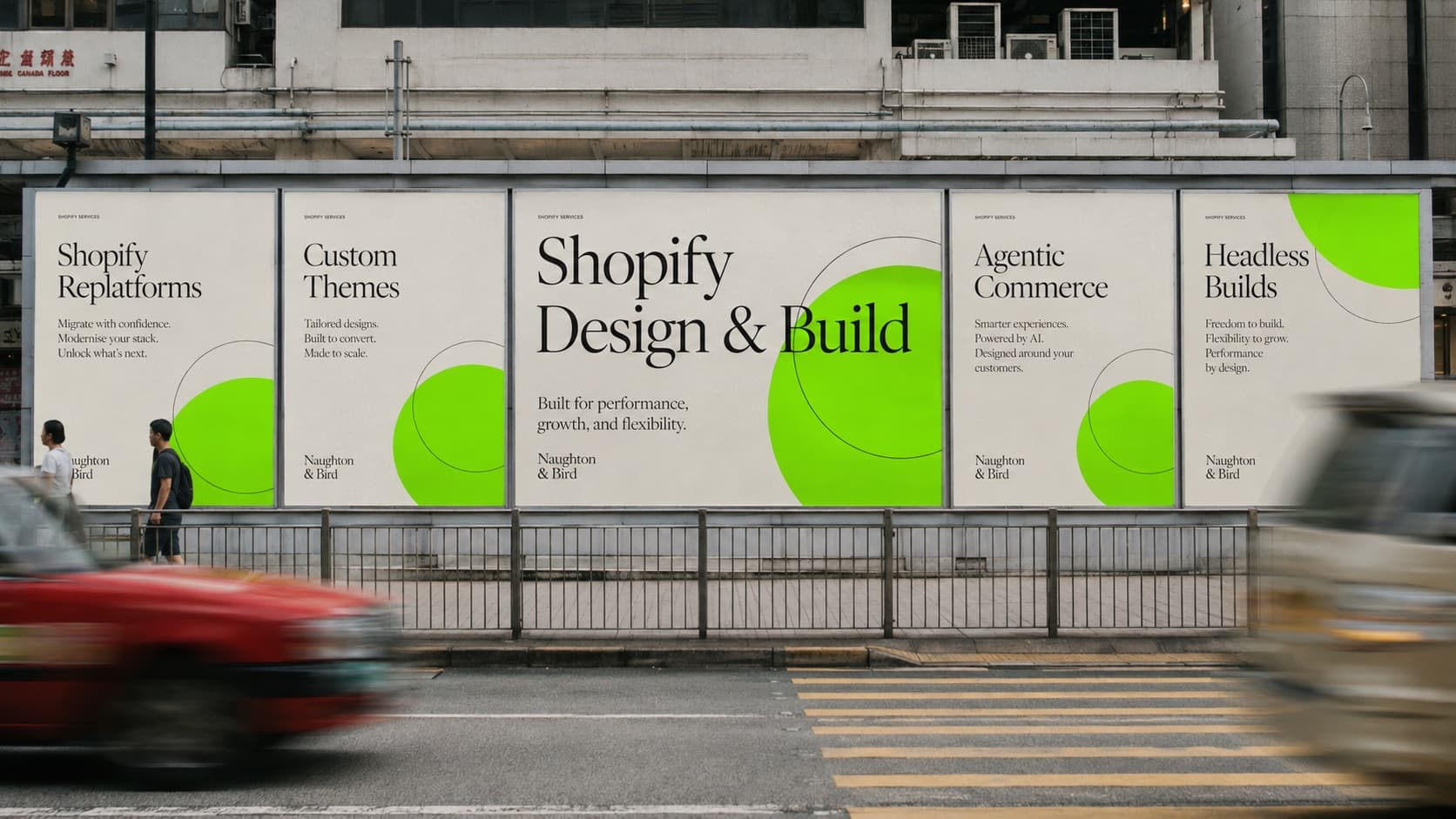
Naughton & Bird Shopify design and build billboards on a Hong Kong street as a red taxi passes

A store is worth rebuilding when it moves conversion, order value or traffic. Everything else, the speed, the tooling, the hours your team gets back, is real, and it only matters because it lands in one of those three.

Matt Naughton · Founder, Naughton & Bird

Shopify Builds

The case

A new store is only worth building if it delivers commercial impact

The brands we work with know their brand inside out: the identity, the pillars, the messaging, the personas, the photography, the packaging. The social channels are strong, the PR runs in-house, and there is serious equity built. The website is usually the one place that identity gets compromised, on a theme that was never built for the brand, or a custom build that does not fit its goals.

A new store has also become a heavy decision. The budget is a genuine outlier, the timeline is a real commitment, and the opportunity cost is the part nobody prices: your team pulled away from what they do best to teach an agency the brand. A store built that way tends to arrive looking right and doing very little.

So we start from the commercial question and work backwards. What would have to be true for this store to convert better than the one it replaces, carry a higher order value, and earn more traffic? Everything after that, the research, the architecture, the design, the platform decision, is in service of the answer.

Builds, replatforms, and themes

We design, build, and launch Shopify stores as a Shopify Plus Partner, and we lead every rebuild from the research through to the protected launch.

One engagement runs end to end, so the work moves quicker and nothing falls between briefs. How the store is built, on a custom theme or headless, is a decision the research makes for you.

The research

Nothing is designed until the research is done

Before a layout exists, we work through the brand and how it speaks, the audiences and the job each one is trying to do, the range and how it is priced, the channels the brand already trades on, the practice worth borrowing from elsewhere in the category, the current store audited in full, and the systems the new one has to talk to.

That work produces a single specification, ordered by what each decision is worth. The design is measured against it, so a template is either serving a finding or it is decoration, and that argument happens on paper.

How a discovery-led build runs

The order is the same whether the build is a new theme, a headless storefront, or a move to Shopify from another platform.

01

The research

We spend the first phase learning the business rather than designing for it: what it sells, who buys it, where it already trades, and where the current store helps or hinders that.

02

The synthesis

The research resolves into one document: what the store has to do, in what order, and what each decision is worth. Every later argument about a template or a feature gets settled here rather than in a design review.

03

Designed to the findings

Design starts once the answers exist, so the layouts serve decisions the research already made. Every template and component is agreed on paper first, and each one earns its place by what it does for conversion, order value or traffic.

04

Discovery specified, then built

The territory map, the URL structure and the structured-data specification are written into the build rather than added to it, so every template knows what it has to say to a search engine and to a shopping agent.

05

Protected through launch

The store is benchmarked before the switch and tested against a pass-or-fail list: URLs, redirects, structured data. After the switch we monitor and stabilise, and the launch is signed off when every critical item passes.

06

Handed over

Documentation, the controls your team runs day to day, and the training to use them. The store leaves our hands able to be changed by the people who own it.

A spiral atrium of timber slats opening to a skylight at The Upper House, Hong Kong

Why Naughton & Bird

Two decades of e-commerce discipline

We are a Shopify Plus Partner consultancy, working the fundamentals of winning and keeping customers since 2008. The discipline search engines and agents now reward, authoritative, structured, truthful commerce, is the discipline we have always practised.

From mail order to Google to agents, the fundamentals have not changed: acquire quality customers at the best possible price, and keep them. We work with established brands whose reputations are already earned, across the UK, Hong Kong, Dubai, and Australia, and we teach your team as we go, so the capability stays in-house.

About the Consultancy →

The problem

The wrong time to think about discovery is post-launch

Most brands find out the hard way. The new store launches, and weeks later organic traffic has fallen off the face of the earth, pages have dropped out of the index, and the first place anyone sees it is the revenue line. That is how a brand discovers its build never considered discovery, and by then the damage is compounding.

Coming in to fix it afterwards is our bread and butter, and it is also the expensive way round. Engaging us at the beginning, with the environment built under our control, means the redirect maps, the structured data, and the benchmarks are part of the build itself, and there is nothing to firefight.

Is your store discovery-ready?

Find out exactly what your Shopify store is telling crawlers and agents.

Request a Readiness ReviewShopify Plus Partner

Shopify build FAQs

That is the first question the research answers, and we give the straight answer before anything is scoped. A custom theme covers what most established brands need and runs on the same Shopify architecture crawlers and agents already understand. Headless earns its cost where the template is visibly the bottleneck: slow, generic, or unable to do what the business now needs. A replatform is its own decision, driven by what the current platform is costing you rather than by what a new one promises.

A headless store separates the two jobs every store does at once. Shopify keeps running the commerce: the catalogue, stock, orders, checkout, and payments. The storefront your customers see is built separately, purely for your brand, and reads everything it needs from Shopify automatically. Your team keeps working exactly as before, in the same admin, and product and price changes flow straight through to the site.

Because a design can only be judged against something. Once the brand, the audiences, the range, the channels, the competitive practice and the current store have all been worked through, a layout is either serving a decision the research made or it is decoration. It also settles the arguments early: the expensive version of this conversation is the one that happens in a design review three weeks before launch.

Yes, daily, exactly as now. Same admin, same orders, same discounts, and nothing new to learn: only the customer-facing site changes. Products, prices, images, and stock update instantly through Shopify, and landing pages and campaign content are composed in a content system built for the job, so marketing keeps those too. What becomes developer work is the structure underneath, the templates it all sits inside.

Good, when the discovery layer is designed in from the start. Shopify's default architecture is widely understood by crawlers and agents, which works in its favour, and the bigger question is usually the migration: coming from a legacy platform like Magento, BigCommerce, or WooCommerce means your URLs change, and URL paths are one of the biggest areas we see migrations fail, because legacy URLs carry years of history and backlinks. Poorly executed migrations have made 404s more prevalent than ever. Paths designed properly from the start, with the redirect map protecting everything the old URLs earned, is the difference between a launch that holds and one that costs a quarter to recover.

No, and the gap has closed quickly. Building headless is faster and more economical than it was, because of what Shopify's underlying technology now supports, and the total cost of ownership can be lower too: more of the features that would be paid apps in a standard Shopify environment are native to the build. It is case by case per client, but invariably it is better value.

A focused storefront build typically launches in six to eight weeks: the research and the design system first, then the build with working previews every week, then the layer you cannot see, the speed, tracking, and search readiness, then handover with documentation and training. It can be done in four weeks when the brand takes the Naughton & Bird playbook, our standard way of building stores. Replatforms and larger migrations are scoped on their own timelines.

Yes, and that's usually where the interesting part of the brief starts. A brand guideline document is built for situations a marketing team already controls: a print ad or a social post. A live store raises questions the document isn't built to answer: how the identity holds up once it's carrying a full catalogue, and how it travels across every device a customer might use to browse it. We take the guidelines as the identity, and the build is answering the questions a static document was never asked.