Contents
In briefWhat launchedHow it worksIn the CMSWith Facebook and InstagramWhat Catalog readsFor your storeHow to prepareOur takeRelated service
Shopify Agentic Commerce →What launched
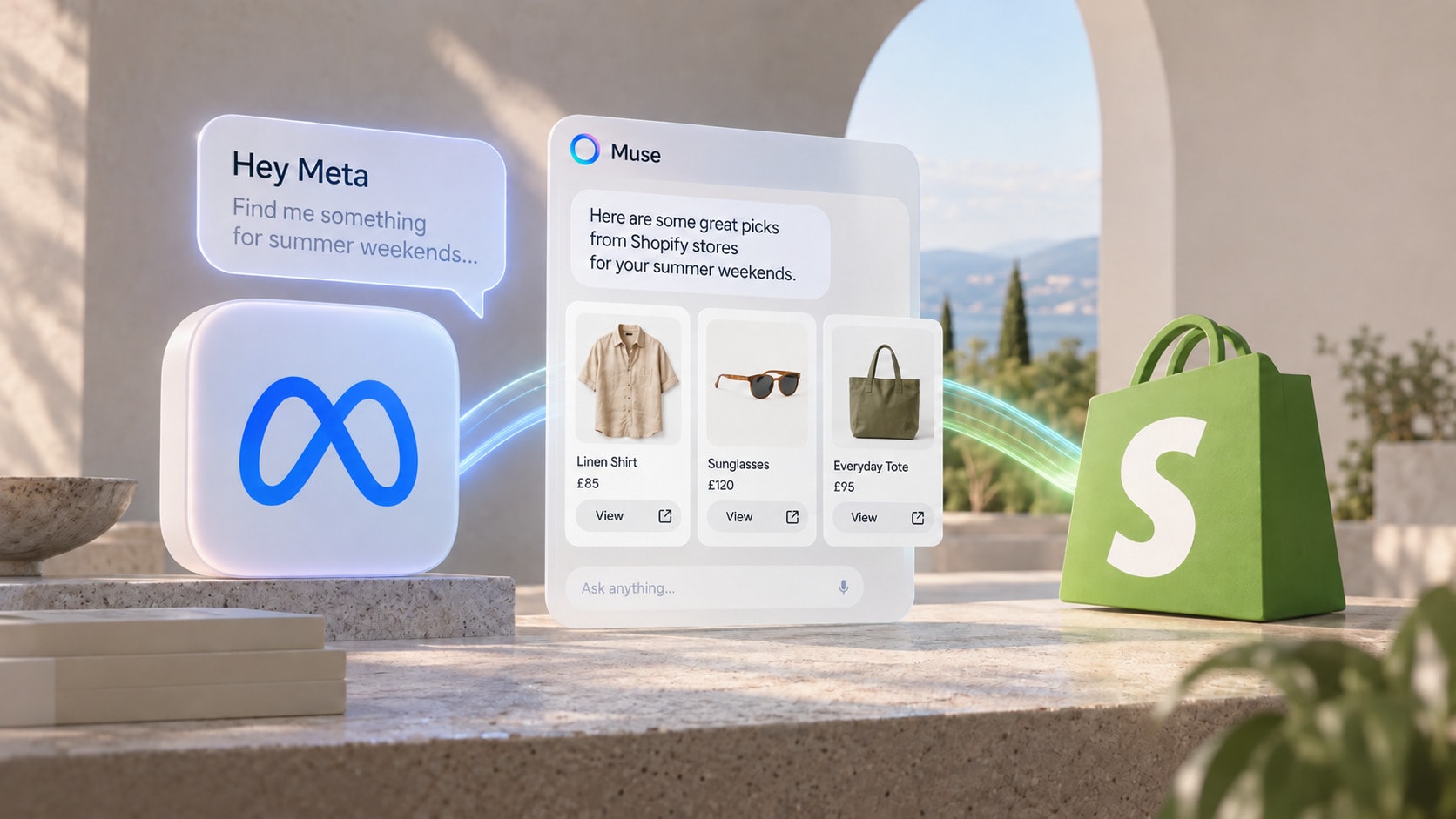
On 8th September 2026 Meta launched Muse, a personal AI agent, much like xAI's Grok Bot. You message it in its own app or in WhatsApp, tell it what needs doing and it goes off and does it, checking with you before it sends an email or spends any of your money. Shopping is part of the job, and the same day Shopify added Meta as an AI channel in Agentic Storefronts, so your products were shared with it by default (you didn't have to do a thing).
Meta just launched a brand new app. Muse.
Here's what matters if you're a founder: Shopify merchants are already discoverable. If your products are in Shopify Catalog and shipping to the US? You're in.
Muse didn't exist yesterday. Today our merchants can already sell through it.
That's the advantage of building on @Shopify in the agentic era.
Harley Finkelstein (Shopify's president) sums it up in the post above: if your products are in Shopify Catalog and you ship to the US, you're in. Shopify's own post adds that when someone uses Muse for shopping, it searches Shopify Catalog for the best match. Muse is rolling out in the United States first, so that's where this matters for now. Let's look at how a purchase works.
How a purchase works
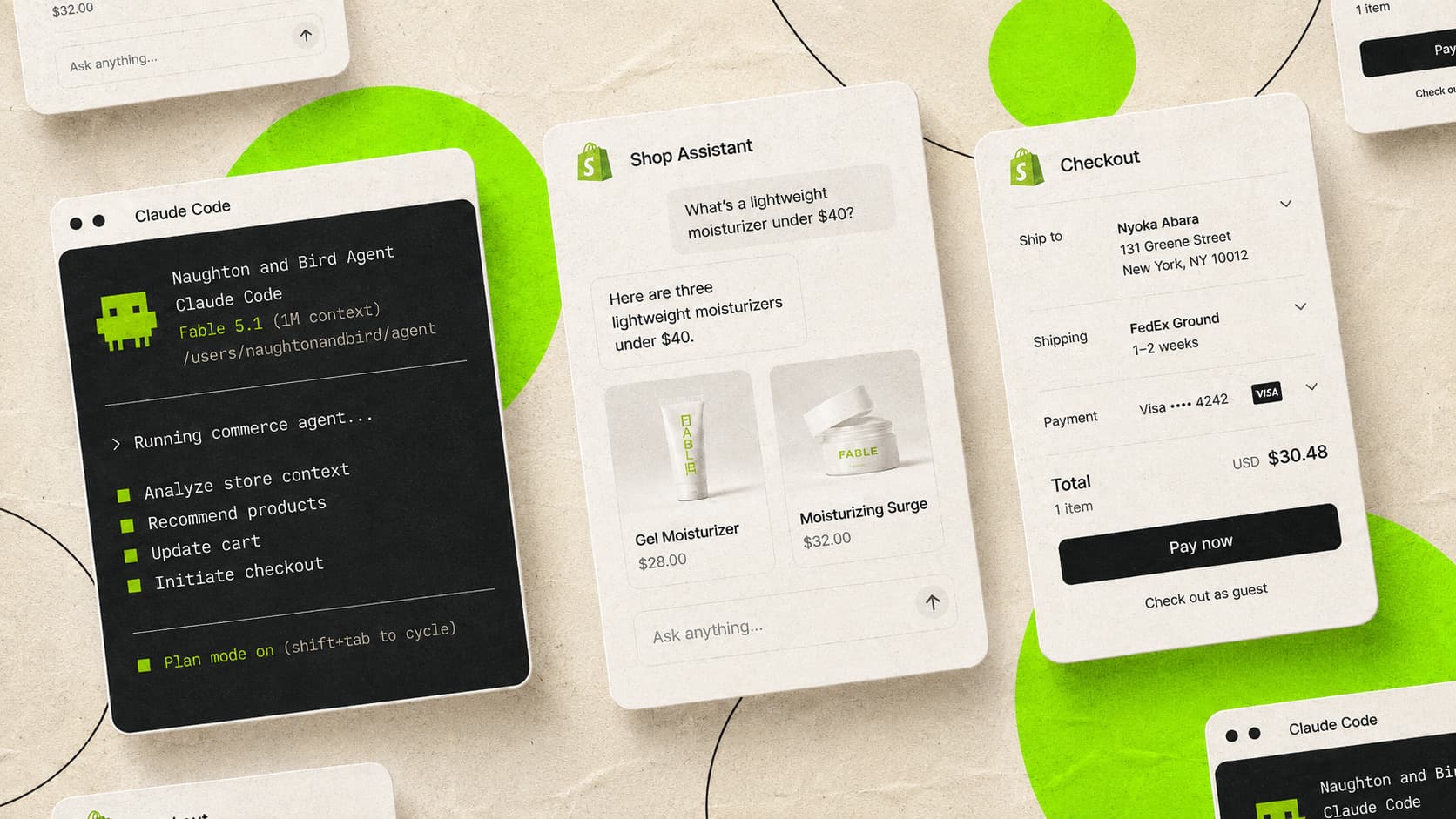
- The customer tells Muse what they're after, and Muse searches Shopify Catalog for the best match.
- Muse shows them the total and asks them to approve it in the chat before anything is spent.
- With direct checkout on, the customer pays without leaving Meta and the order lands in your Shopify admin, tagged to Meta like any other channel's. With it off, they're sent to your store to pay.
How they pay has moved since launch. Meta's launch post had Muse paying through Link, Stripe's wallet for agents, and said Shop Pay was coming soon as another way to pay. Then on 21st September Tobi Lütke (Shopify's CEO) posted this.
We are excited to announce we are partnering deeply with Muse to enable agentic checkout with Shop Pay on all Shopify stores, offering people an easy and delightful way to shop and check out with Muse.
Shopify followed that up on 24th September.
Agentic checkout with Shop Pay ✅
Shop Pay is now available as a wallet in @Muse
So Shop Pay now sits alongside Link in Muse, though as of 24th September Meta's own launch post still says coming soon. You stay the merchant of record, and Shopify's Help Center says direct checkout on Meta carries no fee beyond your usual payment processing.
What it looks like in the CMS
Agentic Storefronts is a sales channel in your admin, under Sales channels, then Agentic, and ChatGPT, Google AI Mode and Gemini, Microsoft Copilot and now Meta are the AI channels inside it. Shopify switched it on in March and gave it its own admin page in May, with performance across the AI channels, the queries you rank for and recommendations for improving your product data, so Meta turned up in a place you can already open.
Meta has two switches and both are yours. To change either one, switch off Allow Shopify to manage for me first, then click Meta.
- Shopify Catalog access shares your products with Meta and is on by default. Switch it off and the share stops, though Shopify warns that Meta may still reference your products through web crawling and indexing.
- Direct checkout lets a customer buy without leaving Meta. It's on by default for eligible stores, which starts with selling to customers in the United States, Canada or Mexico, and only customers there see it. Switch it off and people can still find you, but they're sent to your store to pay.
Direct checkout doesn't run everything your own checkout does, and Shopify lists the gaps.
- Subscriptions, product bundles, customisable products and B2B-only products.
- Checkout blocks, so Meta may render the checkout differently from yours.
- Local delivery, pickup in store and pickup points.
- Google Analytics and your custom pixels. Only server-to-server events fire, for the start and completion of checkout, because the checkout runs on Meta and your storefront never loads.
Shopify Functions (your custom shipping, discount and validation logic), automatic discounts and discount codes all work. If your paid measurement lives in browser pixels, talk to whoever runs paid before you leave checkout on.
How it fits with Facebook and Instagram
The Facebook and Instagram by Meta sales channel is unchanged, and it still feeds your shoppable ads, so keep product syncing switched on there. The AI channel is a separate connection that takes your products from Shopify Catalog. Keep your product data and policies current in both, because Shopify says what customers see on Meta has to match your store.
On 29th September 2026 Meta launched Muse for Small Business. It adds skills and connectors so Muse can work with the tools a business already runs, and the list includes Shopify and Klaviyo, along with Facebook and Instagram business accounts.
You connect Klaviyo inside the Muse app and then ask in plain language. Klaviyo's write-up says Muse can read campaigns, flows, segments and revenue, and it can draft a campaign and schedule a send. Meta says nothing publishes, sends or spends without your approval, and Klaviyo's own examples stop at a draft for you to approve. Klaviyo also posted it on LinkedIn: Klaviyo is now available in Muse.
What Catalog reads
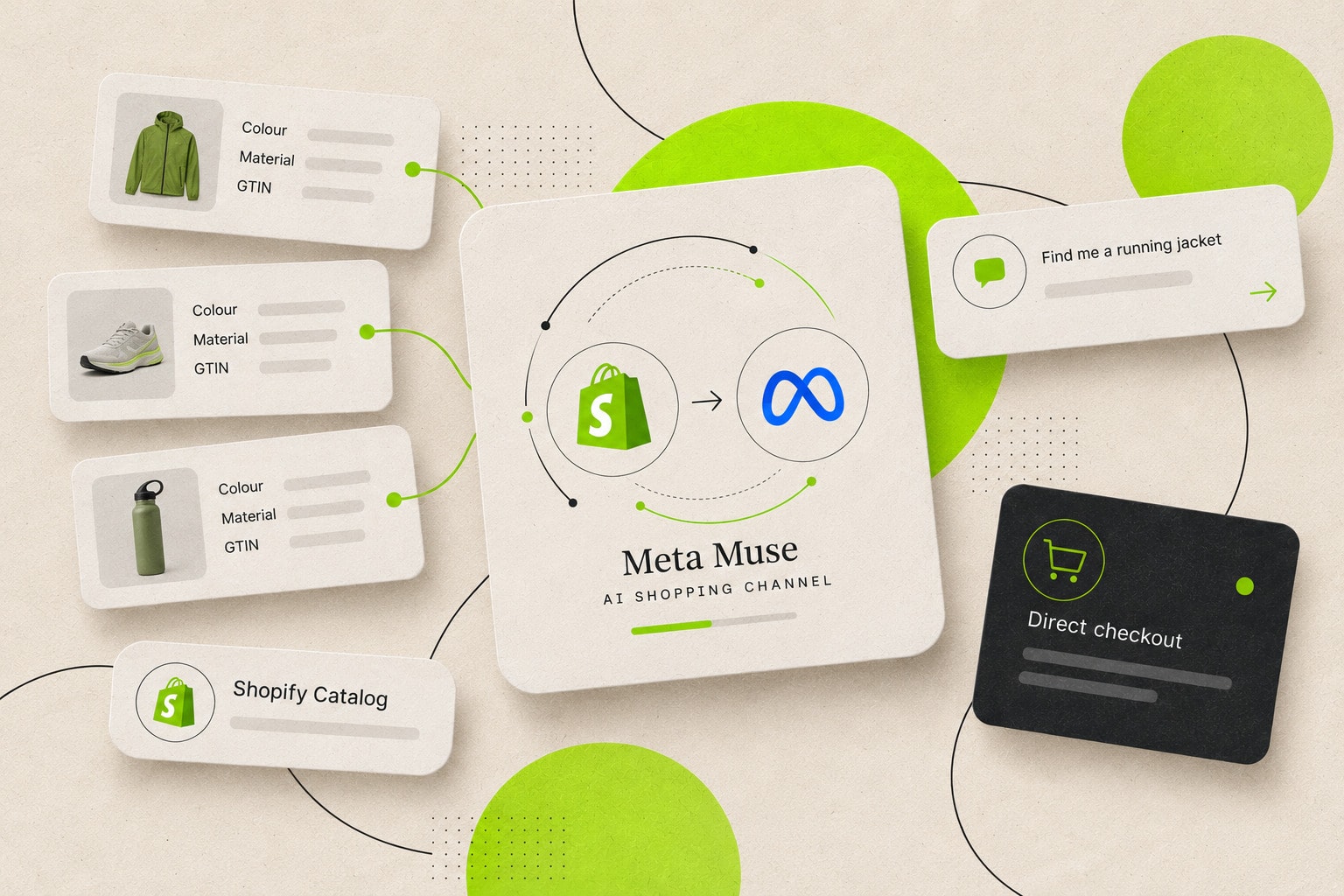
When Muse shops through Shopify it searches Shopify Catalog, which holds your title, description, options, images, price, availability and other key attributes, with stock and pricing kept current across every AI channel. Meta is one more door into the same Catalog that ChatGPT and Copilot already read.
The gap we see most on older stores is that colour, material and size, the things a shopper would ask about, live only in the description, written for a person skimming the page. A person can find the colour in a paragraph and a filter or a feed can't. Options cover the variants, and category metafields, the structured attribute fields that come with a product's category in Shopify's taxonomy, cover the rest. Shopify says they make products more discoverable on your site, on marketplaces and on search engines, which is why we put the facts there as well as in the copy.
If your data already lives in custom fields, Shopify's Catalog Mapping tool lets you say where Catalog should look. It sits in the Sources section under Sales channels, then Agentic, with a preview of what's sent for any product. You can point the title, description and category at a metafield or metaobject and choose how variants are grouped, and changes take a while to process. Plenty of stores won't need to change anything, but it's worth a look if you've built your catalogue around metafields, tag prefixes or delimiters in titles.
Then there's the feed, the file that carries your products to Google Merchant Center and to Meta's own catalogue for paid. A lot of brands are running one somebody else set up, and the login went with them, so nobody at the brand can fix it when it goes stale. An enhanced feed is the whole nine yards: proper titles, the attributes filled in, live availability and rules that keep Merchant Center and Meta matching the store. DataFeedWatch is one we use, and if you sign up through this link we'll get a small commission. It connects to Shopify and reads your metafields, and because the account is yours you keep the login and the rules.
For your Shopify store
Start with where you ship. Shopify lists selling to customers in the United States, Canada or Mexico as a requirement for selling on Meta, and Muse is rolling out in the US first, so if you don't ship to any of them this is one to keep an eye on.
If you do ship to one of them, being in takes no work, so every eligible store arrived the same day you did, and what sets you apart is the product data behind your listings.
With ChatGPT the customer finishes on your own checkout, and with Meta's direct checkout they can pay without your storefront loading at all, so those orders arrive in your Shopify admin attributed to Meta and never show up in your browser analytics.
How to prepare
- Open Sales channels, then Agentic, and check Meta is in the list with Shopify Catalog access on. Leave it on unless you have a reason to stop sharing, and read the performance data and product recommendations Shopify shows on that page while you're there.
- Decide on direct checkout. If you sell to the United States, Canada or Mexico it's on by default, and your browser pixels won't fire on it, so if your paid measurement lives there, agree the call with whoever runs paid. Switching it off still lists you and sends the buyer to your store.
- Check Settings, then Policies. Shopify needs your Terms of service, Privacy policy and Return and refund policy completed and the Agentic Storefronts supplemental terms agreed. Put any legal disclosures in the first 6,000 characters of the product description.
- Open the Sources section on the Agentic page and preview a handful of hero products the way Catalog sends them. If colour, material and size only live in the description, put them on the product as options or category metafields.
- Check who owns your feed. If it's still with a former agency, move it to an account you control. Or ask us to read your catalogue, as part of a readiness review.
Our take
Muse arrived six days after Claude Commerce Agents, and if your store is discovery-ready you were ready for both. Muse searches the same Shopify Catalog that ChatGPT already draws on, so the brands whose product data and policies were right before 8th September were in front of it the day it launched.
We'd steer clients away from building anything specific for a personal agent like Muse. You could, but ChatGPT is already bringing our clients revenue through the Agentic channel in Shopify, and the same product data serves Muse. Get that data and your policies right once and every channel Shopify turns on reads the same fields, so the next agent is another reader of a job you've already done.
Shopify is the place to connect. Catalog gets you found, checkout takes the order, and Shop Pay is now a wallet in Muse (Shopify announced it on 24th September). We don't read this as a Meta story, because ChatGPT, Copilot and now Meta all read the same Shopify Catalog, which is as close to standardisation as we've seen in this space. Someone told Harley Finkelstein that agents don't need Shopify because every website is on this from day one, and this was his answer:
Wrong. Agents need to find the right product (Catalog), pay securely (Shop Pay), and complete the transaction reliably (Checkout via UCP). Meta, Google, Microsoft and OpenAI all built on exactly that. 'Every website is on this on day one' is a nice theory. Structured data, trusted payments and deterministic APIs are what actually work.
Tell me again how I'm misunderstanding how agents shop.
We think more of your orders will start in channels like this one, and this is the first step towards orders that start in an agent and never touch your storefront. It's exciting, and with Meta involved (Muse was built for billions of people and lives inside WhatsApp) it's big.
Catalogue and agentic readiness come first. Muse for Small Business is Meta's agent reaching into email and SMS operations, and it is not a new storefront channel.
Sources & references
- Shopify Changelog, Meta is now an AI channel in your admin(changelog.shopify.com)
- Shopify Changelog, A new home for Agentic Storefronts in your admin(changelog.shopify.com)
- Shopify Help Center, Shopify agentic storefronts(help.shopify.com)
- Shopify Help Center, Selling on Meta(help.shopify.com)
- Shopify Help Center, Shopify Catalog and product discovery for agentic storefronts(help.shopify.com)
- Shopify Help Center, Mapping your product data sources for Shopify Catalog(help.shopify.com)
- Shopify Help Center, Category metafields(help.shopify.com)
- Meta Newsroom, Introducing Muse(about.fb.com)
- Meta Newsroom, Introducing Muse for Small Business(about.fb.com)
- Klaviyo blog, Connect Klaviyo to Meta Muse(klaviyo.com)
- Klaviyo on LinkedIn, Klaviyo is now available in Muse(linkedin.com)
- Meta, Muse(ai.meta.com)
- Muse on YouTube, Take the full tour of Muse, Meta's personal AI agent(youtube.com)
- Stripe Newsroom, Stripe helps Muse, Meta's new personal AI agent, shop across the internet with Link(stripe.com)
- Harley Finkelstein on X, Meta Muse and Shopify Catalog discoverability(x.com)
- Shopify on X, Muse searches Shopify Catalog and checkout happens in the app(x.com)
- Harley Finkelstein on X, Catalog, Shop Pay and checkout via UCP(x.com)
- Tobi Lütke on X, agentic checkout with Shop Pay on all Shopify stores(x.com)
- Shopify on X, Shop Pay is now available as a wallet in Muse(x.com)