Contents
In briefWhat it isThe test question setA worked entry setLoading itOur takeQuestionsRelated service
Shopify Agentic Commerce →What the Knowledge Base is
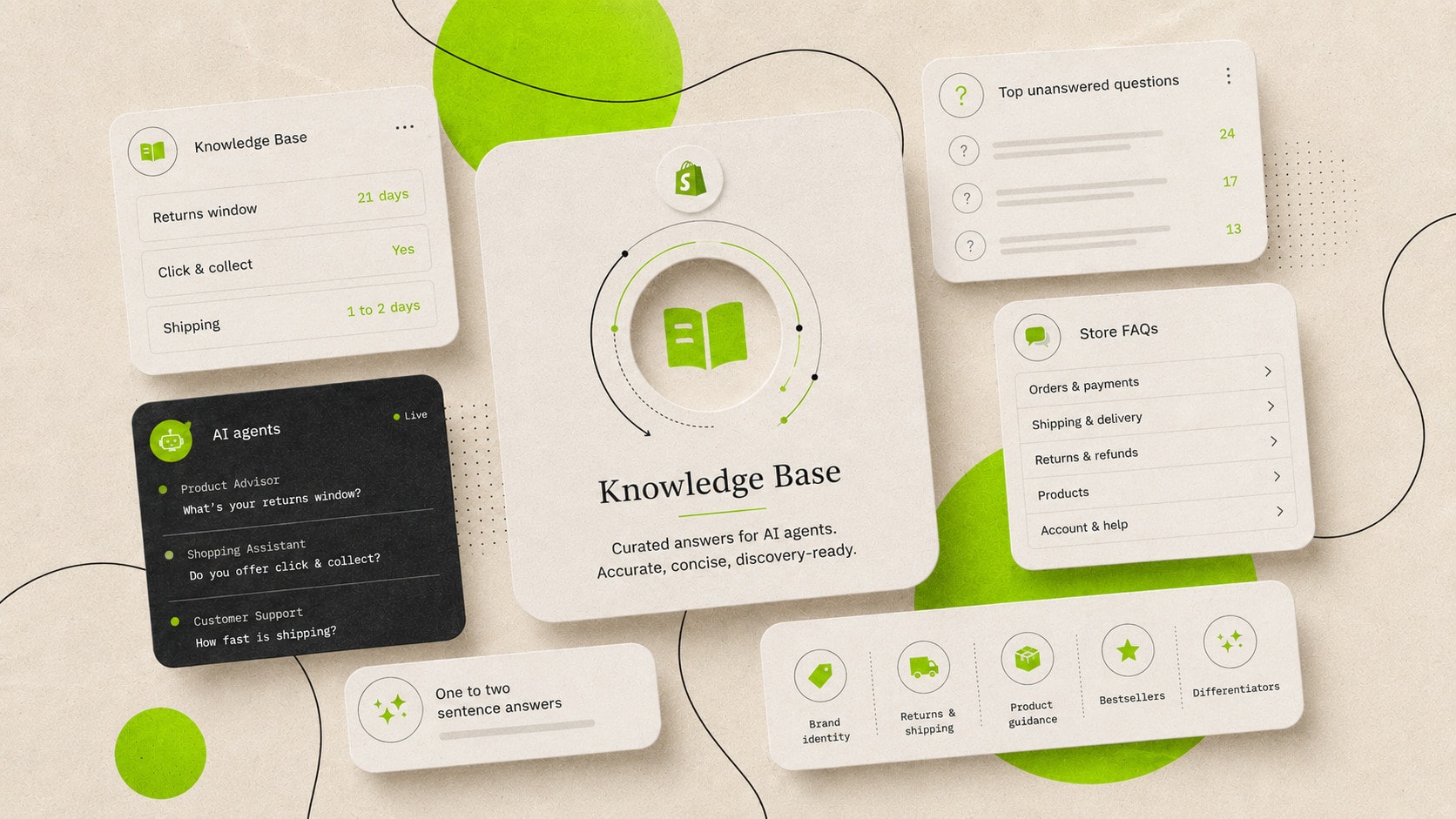
The Shopify Knowledge Base is a free, Shopify-built app that holds the question-and-answer pairs AI platforms read when they answer questions about your store. When a shopping agent is asked about your returns policy, your shipping coverage or what the brand is, it reads this feed instead of scraping your About page and guessing. Shopify describes it as a trusted data source for AI platforms, launched in May 2025 and installable from the App Store in a minute.
Nothing in it displays on your storefront, because it is backend infrastructure read by machines and invisible to human visitors. Shopify is also explicit that curating it improves the accuracy of what AI platforms say about your store and does not change how often the store appears, and on that basis it is one of the highest-value hours a merchant can spend on the agentic channel.
How agents read it
Entries are stored as Shopify metaobjects, visible in the admin under Content, and distributed two ways. Neither route involves anyone visiting a page.
- The storefront MCP tool search_shop_policies_and_faqs, which any agent can call against the store's /api/mcp endpoint and receive the question-and-answer pairs as structured JSON. This is the same interface family covered in our piece on the UCP migration, and the policies tool is unauthenticated, so you can read your own feed the way an agent does.
- Shopify's syndication to connected AI surfaces through the agentic storefronts channel, where the same verified facts travel alongside structured product data to ChatGPT, Gemini, Copilot and the other connected platforms.
The feed works before anyone touches the app. Shopify auto-generates answers from store settings, policies and catalogue data, and serves them to agents today, on every store, errors included, so installing the app shows you what the feed has already been saying.
What we found when we captured a live feed
As the baseline step of a recent engagement, we captured a live store's feed by querying search_shop_policies_and_faqs with 28 questions a shopper would ask: returns, exchanges, delivery costs and times, click and collect, gift services, appointments, care, sizing, warranty and payment. The store is a premium brand with a strong team, and nobody had ever opened the app.
Thirteen of the 28 questions returned nothing at all. No answer on refund timing, delivery cost, appointments, ring sizing, resizing, care or warranty, each an empty response an agent has to fill with a shrug or a guess.
The answers that did come back were the bigger problem. The returns answer stated a shorter window than the policy page it was meant to summarise. Click and collect came back as a raw system record, location ID and machine-formatted pickup time included, with nothing a buyer could act on. A gift service was confidently advertised that the store does not sell. Every one of those answers was live, being served to any agent that asked.
None of this is unusual, and Shopify's own documentation is upfront that auto-generated answers are a starting point to review. Once agents are in the buying journey the review step stops being optional, because an unanswered question costs a sale and a wrong answer causes a service incident.
The question set to test your own store against
The question set is the method, so you can repeat the baseline without our tooling. Ask your store what a shopper would ask it, group by theme, and score each answer as accurate, wrong or missing. This is the set we run, and any store's version differs only in the category-specific block.
| Theme | The questions |
|---|---|
| Returns and exchanges | Returns policy, exchanges, refund timing, sale items, online returns in store, special orders, cancellations |
| Delivery | Cost, timing, free thresholds, international coverage, duties, same-day, click and collect |
| Store and service | Visiting a store, appointments, trying products, gift wrapping |
| Product confidence | Care instructions, sizing, alterations or resizing, warranty and guarantees |
| Payment and trust | Payment methods, buy-now-pay-later options, sustainability practices |
Run the set in the Knowledge Base app itself if the store is yours, or through the policies tool on the MCP endpoint to see the response as an agent receives it, which is covered step by step in how to test what a shopping agent sees. Twenty to thirty questions covers a standard premium store, and the scoring takes under an hour.
The three kinds of entry
| Entry type | Where it comes from | What you can do with it |
|---|---|---|
| Auto-generated (Default) | Generated by Shopify from store settings, policies and catalogue data | Cannot be deleted. Override the answer, or revert to the default |
| Manual | Created by the merchant via Add FAQ | Fully editable and deletable |
| From unanswered questions | Real agent queries the feed could not answer, listed in the app | Answer them in place, which creates a manual entry |
The third type is the one to watch. The Top unanswered questions log lists the things real buyers asked real agents about your store with no answer available, which makes it a free source of genuine FAQ demand that no keyword tool can see.
The five categories to load
Auto-generation covers settings-derived facts at best, so the substance of the work is custom entries. We load every store against the same five categories, typically 15 to 25 entries in total.
- Brand identity and positioning. What the brand is, who it is for, and what makes it the right recommendation, written as the direct answer to "What is this brand?". This is the single most important entry in the feed.
- Return and shipping policies. The actual terms in plain English: return window, process, free thresholds, timeframes by region, international coverage. Stated to match the policy pages exactly.
- Product category guidance. Which collections serve which use cases and occasions, so an agent asked for a gift, a first purchase or a specific situation is steered to the right part of the catalogue.
- Bestselling and featured products. A direct answer naming the products you want surfaced and one line on why. This is the nearest thing the agentic layer has to a featured-products signal.
- Brand differentiators. The answer to "why this brand over another", stated plainly, because comparison questions are asked constantly and an agent without your answer will improvise one or concede to a competitor with a clearer story.
A worked entry set for one category
This is the category-guidance block written out, for an illustrative premium footwear brand. The questions are phrased the way an agent receives them from a buyer, and each answer stands alone, names real parts of the catalogue and stays within the two-sentence guidance.
| Question | Answer |
|---|---|
| What boots do you recommend for wet, muddy walking? | The waterproof walking collection is built for exactly this, and the full-rubber styles in it are the right choice when conditions are consistently wet. Neoprene-lined versions add warmth for winter use. |
| What would work as a gift for someone who spends weekends outdoors? | The bestselling waterproof boots are the safest gift, sized generously and exchangeable within the standard returns window. Gift cards are available for buyers unsure of size. |
| What is the difference between your rubber and leather ranges? | Rubber boots are fully waterproof and suited to sustained wet ground, while the leather range trades some of that protection for formality and all-day comfort. Most customers buying for field use choose rubber. |
| Which of your products are most popular? | The classic waterproof boot is the consistent bestseller, followed by the neoprene-lined winter version. Both are stocked in the full size range year round. |
Every answer steers towards a named part of the range, states a fact an agent can safely repeat, and answers the likely follow-up question inside the first. Repeated across the five categories, the feed becomes a sales assistant's knowledge in a form a machine can relay without mangling it.
Writing answers an agent can relay
Shopify's guidance throughout the app is a brief one-to-two sentence answer, and the guidance is right, because whatever you write gets relayed, summarised or quoted by a consuming agent, and short declarative answers survive that intact.
Write the answer so it stands alone without the question, because that is how it arrives in an agent's context. An answer of "Yes, within 21 days" degrades badly when the question is lost, while "Unworn items can be returned within 21 days of delivery for a full refund" survives on its own. Lead with the fact, keep one condition if one matters, and put everything else on the policy page the entry points to.
Keep the feed consistent with everything else machines read. The returns window in the Knowledge Base, the policy page, the schema markup and the agents.md file must state the same number, because an agent that meets two different answers trusts neither, and holding one fact to one value across every surface is the working core of discovery-readiness.
Loading it: the exact flows
- Create an entry: Apps, then Knowledge Base, then Add FAQ. Enter the question, a one-to-two sentence answer, and Save.
- Fix an auto-generated answer: click the FAQ in Store FAQs, choose Override next to the information source, edit the answer and Save. Return to default reverts it later if the underlying settings change.
- Answer real demand: in Top unanswered questions, hover over a question, choose Answer, tidy the question wording if needed, write the answer and Save.
- Delete only manual entries. Auto-generated facts cannot be removed, only overridden, which is why wrong defaults have to be corrected.
Shopify documents no bulk import, CSV path or API route for entries, so they go in one at a time through the admin at roughly a minute each. A 20-entry set is an unhurried half hour, and the writing beforehand is where the real time goes.
Constraints and maintenance
Three constraints shape the ongoing work. The app is English-only as of mid-2026 according to merchant reviews, which multi-language stores need to plan around. Answers should stay within the brief-answer guidance because long entries get truncated or summarised downstream. And the feed inherits every policy change, so updating the Knowledge Base belongs on the same checklist as updating the policy page itself, on the same day.
The app's own metrics close the loop: it reports how often AI agents request your store's information and which questions they could not answer. Reviewing the unanswered-questions log monthly, and re-reading the auto-generated answers after any settings change, is the whole maintenance burden. It is small, and skipping it is how feeds drift back into misquoting policies.
One date for anyone testing the feed directly: Shopify is migrating the storefront MCP tools to UCP-conforming equivalents, and responses from the old /api/mcp endpoint already carry a deprecation notice pointing at 31 August 2026. The Knowledge Base itself is unaffected, and any scripts or tooling reading the feed through the old endpoint will need updating with the wider migration.
What the Knowledge Base will not do
It will not make your store appear in more AI answers, and Shopify says so directly. Appearance is governed by how the wider models see the brand, by the catalogue data in Shopify Catalog, and the authority signals the platforms weigh. What the Knowledge Base governs is whether the store is represented accurately once an agent is talking about it.
It is also not a customer-facing FAQ page, and merchants who install it expecting a storefront feature find nothing to see. If you want visible FAQs for humans, they live in your theme with FAQPage schema, and the Knowledge Base runs in parallel behind them, stating the same facts to a different reader.
Our take
The surprising thing about the Knowledge Base is that it exists at all. Shopify hardly promotes it, and almost nobody understands what it is there to do. The answers it gives are synthesised and they are passable, but they depend on the store being built a certain way. If a lot of your content lives in the theme, it cannot read it. It needs facts that sit in the CMS layer, in metadata, metafields, descriptions and policies. Anything sitting inside JavaScript or the theme's Liquid is often out of its reach.
Showing a client the answers their store is currently giving agents is a eureka moment every time. Nobody wants their store telling customers the wrong thing, and every client we have shown it to has wanted it addressed straight away. It is a litmus test.
Against agents.md it is the smaller priority for now. It is manual, and its use case runs through the storefront endpoint, so its adoption will grow as that grows, while agents.md is the file the sitemap points at and the one that gets crawled first. But the Knowledge Base is a signal that has to line up with your entity and with everything else you say, and you cannot be answering incorrectly, so it stays on the list.
Questions we hear about the Knowledge Base
Yes. It is built by Shopify, free to install from the App Store, and carries no subscription. The cost is the hour or two of writing and loading the entries.
No. Nothing in the Knowledge Base displays on the storefront. It is a data feed read by AI agents, entirely invisible to human visitors.
Yes, if agents are asking. Shopify auto-generates answers from your settings and serves them whether or not the app has been installed or reviewed, and in our experience the auto-generated set contains errors worth correcting.
No, and Shopify says so plainly: the app improves the accuracy of AI responses about your store, without affecting how often you appear. Visibility is built through the catalogue, authority and entity work that sits alongside it.
Plan around English for now, as merchant reviews report the app is English-only as of mid-2026. Keep the English entries canonical and watch for Shopify to extend language support.
Sources & references
- Shopify Help Center, Shopify Knowledge Base(help.shopify.com)
- Shopify Help Center, Managing your store FAQs using the Shopify Knowledge Base app(help.shopify.com)
- Shopify App Store, Shopify Knowledge Base(apps.shopify.com)
- Shopify developer documentation, Storefront MCP(shopify.dev)
- Shopify developer changelog, Storefront MCP cart tools are being deprecated in favour of UCP Cart MCP(shopify.dev)