
Contents
In briefThe short answerThe three signalsTesting your standingThe planWhat to expectOur takeRelated service
Shopify Agentic Commerce →The short answer
There are now two doors into ChatGPT for a Shopify brand. Brand citations, being named when a buyer asks for recommendations, are earned through authority, entity clarity and citable content, and none of those can be bought. Product listings arrived separately: since March 2026, products from eligible Shopify stores are discoverable in ChatGPT by default through Agentic Storefronts, so the product door is already open and the work there is data quality.
A brand can be listed without ever being recommended, and being recommended is where the compounding value sits, so the two need separate treatment.
How ChatGPT forms brand recommendations
ChatGPT's recommendations are not paid placements, and they are not a straight reflection of search engine rankings. They come from two places, the model's training data and live web search, which has been available to every ChatGPT user since early 2025 after launching in October 2024. When a buyer asks for a recommendation, the answer blends what the model already believes about a category with what it retrieves at that moment.
The model recommends brands that appear consistently in authoritative contexts, across multiple sources, with specific and relevant information about their products and positioning. A brand that has been written about in the right publications, cited in buying guides, and carries structured content that clearly defines its category and customer is far more likely to be recommended than a brand with the same product quality and no external presence.
The language ChatGPT uses about a brand is usually a paraphrase of the brand's most authoritative coverage, so the way to change what the model says is to change what the sources it trusts say, and the brand's own site is only one of those sources.
The product door: already open
The product side moved without most merchants noticing. OpenAI opened purchases inside ChatGPT in September 2025, Shopify merchants joined at launch, and in March 2026 Shopify switched on Agentic Storefronts for every eligible store, letting products surface in ChatGPT automatically through Shopify Catalog, with purchases completing in an in-app browser on mobile and on the merchant's own store on desktop.
The work behind this door is unglamorous: product data complete enough for the Catalog to structure it well, policies stated where the agentic feeds read them, and the channel toggles reviewed in the admin. A store can hold excellent listings behind this door while remaining invisible through the recommendation door, and most eligible stores are in that state today.
The three signal types behind citations
Owned signals, meaning what the brand's own website communicates about itself. Clear product descriptions with specific buying context, FAQ content that answers the questions a buyer would ask ChatGPT, and structured data that makes entity recognition easy.
Earned signals, meaning press coverage, buying guide inclusions, review mentions and links from authoritative sources. These carry the most weight in how models form their view of a category, and they take the longest to build, which makes PR and content outreach a long-term investment with compounding returns. The venues that matter are the ones models treat as evidence: established publications, genuine community discussion, and the comparison content buyers trust.
Structured signals, meaning schema markup, especially the Organisation, Product and FAQ types, which give models machine-readable context they can process without guesswork. Markup is not a shortcut to citation, but it removes friction from entity recognition, and models lean on whatever is easiest to read with confidence.
What ChatGPT reads from your store
Three surfaces feed what ChatGPT knows about a Shopify brand, and each is checkable. The first is live pages, read when search triggers browsing, which makes crawl access the first check: a robots.txt blocking GPTBot is opting out of retrieval, and several stores we audit are still carrying blocks added in 2023 for different reasons. The second is product data, through Shopify Catalog and the agentic channel, which structures whatever the admin contains. The third is the policy and FAQ feed, the same Knowledge Base layer that answers agent questions about returns, shipping and services.
The two doors share foundations. A browsing answer draws on the same catalogue data that makes product listings accurate, and a recommendation quotes the same policies that keep agents accurate.
Testing where you stand
- Write ten buying queries in your category, phrased as buyers phrase them, without your brand name.
- Run them in ChatGPT on a schedule, noting which brands are named, in what order, how each is described, and which sources are cited when the answer browsed.
- Run two branded queries too, because the model's description of your own brand is the accuracy baseline, and errors there trace to sources you can fix.
- Check the product door separately: ask for products your store sells and see whether your listings surface in the shopping results.
- Record everything in the same sheet each time, since the value is in the trend across months.
A worked reading: asked for premium linen bedding under £200, an answer that names two competitors with accurate price points and materials, cites one buying guide and one retailer page, and omits your brand entirely, shows that the model can be specific in your category, that it trusts a named buying guide you are absent from, and that the gap is earned coverage before it is content. The same answer naming you with a wrong price means presence is fine and the sources need correcting.
The plan, by lead time
| Horizon | The work | Why it is first |
|---|---|---|
| This month | Baseline test, agentic channel review, entity and schema fixes, policy consistency across the machine-readable surfaces | Fast, owned, and everything later builds on it |
| This quarter | Citable category content: evidence-dense buying guides and comparisons answering the questions buyers ask ChatGPT | Retrieval reads the live web, so good pages can surface in weeks |
| This year | Earned authority: press, buying-guide inclusions, community presence, the coverage models paraphrase | Slowest to build, heaviest in the model's view of the category |
The baseline test in the first row is the same repeated query-set method as the wider citation audit: the buying queries your customers use, asked without your brand name, recorded on a schedule, with competitor appearances and description accuracy noted.
What to expect
Nobody can guarantee a ChatGPT citation, and the checkout picture itself keeps moving, with OpenAI scaling back Instant Checkout in early 2026 while the durable pattern settled on discovery in the conversation and purchase on the store. Build for the durable pattern: be the brand the answer names, and let the transaction land wherever the platforms put it that quarter.
Progress shows first as accuracy, the model describing the brand correctly, then as presence on long-tail category questions, and last on the head queries where authority decides. A quarter of consistent work usually moves the first two, and the third moves on the timescale of the earned coverage behind it.
Our take
ChatGPT is on this list because it is the model we see delivering sales. Across the brands we work with, it is the most widely adopted model in the agentic channel by revenue in Shopify's own reporting. There are no guarantees you get cited, because other brands may be doing as much signal building as you. The more niche and relevant the prompt is to your brand, the better your chances, broad versus long tail again. And be careful how you define being cited. There are billions of versions of the same prompt, two people asking the same thing in the same words is near impossible, especially by voice, and if you ask ChatGPT about your own brand you will of course be cited. If your brand is known for something and you present the story properly, there is a good chance you are included in the synthesised answer, whether as a source or as a recommendation.
It comes back to the fundamentals. Agentic Storefronts switched on, the agentic readiness done, the schema in place, and robots.txt letting the crawlers in. We were engaged by one store to find out why it was not surfacing in ChatGPT at all, and someone had blocked the OpenAI search bot in robots.txt. That was a eureka moment for the client. Base layer first, then the compounding factors, because a brand with reputation, community, PR and signals already happening naturally has far more chance of being referenced. What you can measure today is referral traffic and referral revenue, and that is where we anchor the conversation about timelines.
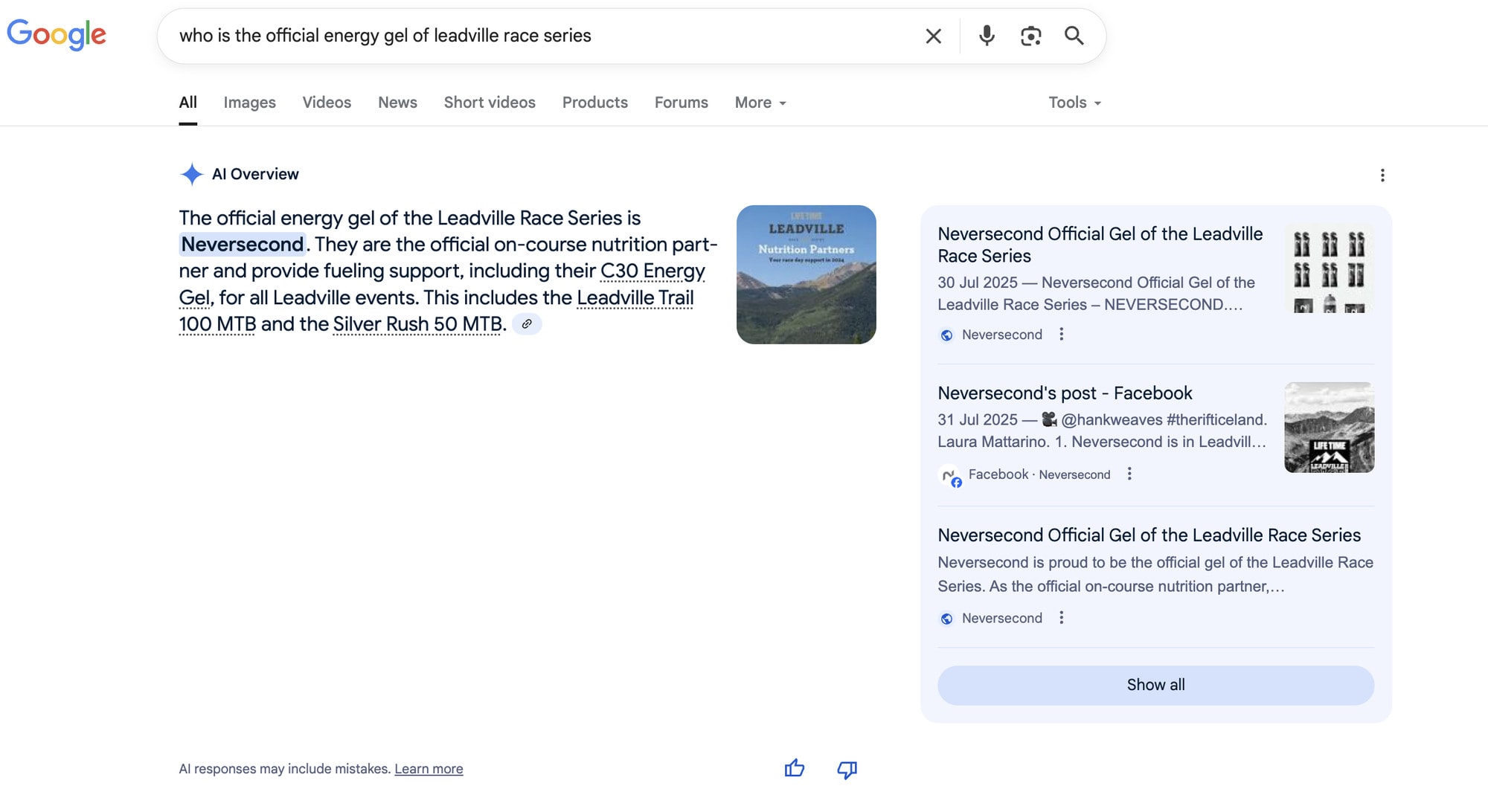
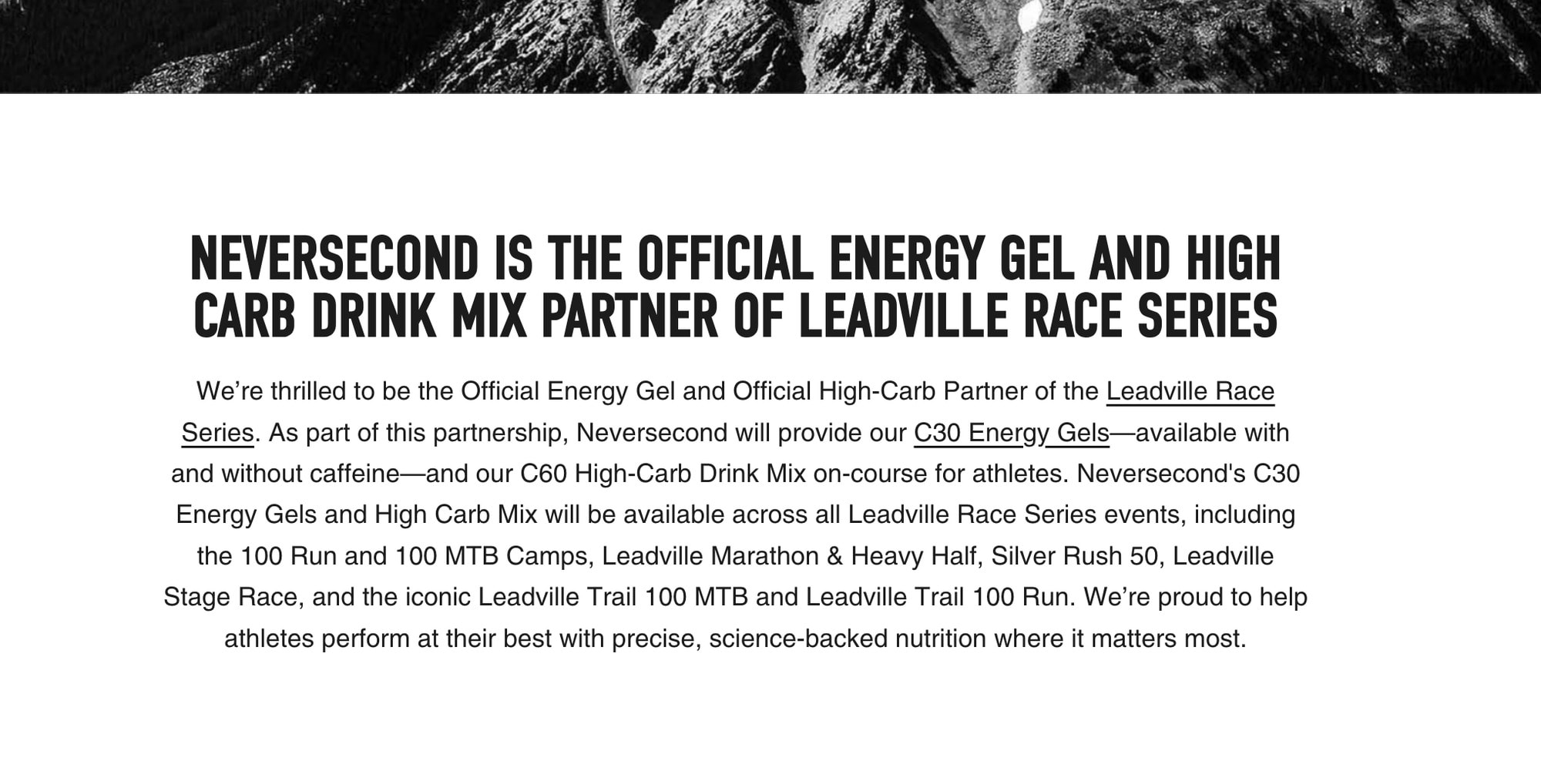
The citation win we saw first-hand shows how fast these models learn. Neversecond, the sports nutrition brand, became the official gel of the Leadville Race Series in 2025. The sponsor changes every year, and both Google's AI Overview and ChatGPT were still naming the previous brand, because neither the event nor the sponsor had put out a formal signal. We did the research, wrote the plan and delivered the activations: a dedicated page on the Neversecond store stating the partnership, the official-gel line added to the C30 gel product pages, the partnership posted on social, and feedback submitted on the AI Overview through Google's own form with the Leadville page as the evidence. We briefed Neversecond to ask Leadville to say the same on the event site with a link back, and they did. The AI Overview changed within 24 hours. ChatGPT followed, and its cited sources were the Neversecond page and the Leadville page, with the brand's social posts a big part of the signal in Google's overview. It was exciting to watch, and it is what led us to pursue discovery-readiness as a discipline, because changes could be influenced almost instantly and queried by anyone, which SEO never allowed.
We always recommend clients do not optimise specifically for ChatGPT. Step out of that thinking, apply the fundamentals and the methodology, and you are on the right track. The beauty of synthesised AI results is that you can influence them quickly, especially when the information is wrong. These models are trying hard to give the best answer they can, and they will always give one, so help them learn the right one. When you explain this to owners, the C-suite or other departments, we recommend the analogy of a supermarket with every aisle sign taken down. The regulars still find the milk, because they know where it lives. A new customer wanders the aisles, and when a friend mentions the shop round the corner has all its signs up, that is where they go next time. Signposting is the whole job.
Sources & references
- OpenAI, Introducing ChatGPT search(openai.com)
- OpenAI, Buy it in ChatGPT: Instant Checkout and the Agentic Commerce Protocol(openai.com)
- Shopify, Agentic commerce momentum: millions of merchants can now sell to ChatGPT users(shopify.com)
- Shopify Help Center, Shopify agentic storefronts(help.shopify.com)